Silicon Ranch is a full-service energy solutions company committed to boosting economies, strengthening communities, and restoring healthy air, water, and soil.
We own and operate every one of our projects for its 40-year+ life, underscoring our deep commitment to the partners and communities we serve.
We do what we say we will do: Since we began operations in 2011, we have successfully delivered every project for every Power Purchase Agreement we have signed. We have accomplished these outcomes through a consistent approach to our development process and choosing the right path over the easier path to get the job done.
We support utilities who pursue an all-of-the above energy-mix strategy. We chose this county because it offers access to a high-voltage transmission line that has capacity to accept additional electricity generation. This made-in-America energy project will produce vital electricity to support Alabama Power Company in meeting increasing energy demand from both homes and businesses across the state.
Yes. Among the many benefits of the Stockton Solar Farm, the infrastructure we will install will bolster the resiliency of the local electric grid. The energy generated by this local solar plant will physically power the closest neighborhoods first before traveling further distances across the electric grid. Power naturally flows to the nearest homes and businesses using electricity because like water, electricity follows the path of least resistance to find its quickest balance. This means the community is less dependent on long-distance transmission lines that are vulnerable to storms or equipment failure. Our energy + ag projects also provide access to land for local farmers and new revenue for both farmers and their suppliers and yield local pasture-raised meat and healthier soil.
No. We are committed to excellent land stewardship. We design our projects to avoid wetlands and other sensitive areas because they are vital for water filtration, flood control, and wildlife habitat. Moreover, federal, state, and local regulations (such as the federal Clean Water Act) prohibit or severely restrict most wetland development and we comply with all regulations. Less than half the land for this facility will be occupied by the solar facility itself. The remaining area will be conserved for visual buffers, setbacks, and avoided protected wetlands.
We recognize our responsibility as neighbors to the Mobile-Tensaw Delta.
We take intentional steps in our facility design, construction, operations, and land management to ensure that the amount of stormwater runoff is less than or equal to the amount of stormwater runoff that exists when we buy the property.
Preconstruction: Our pre-construction land management practices are designed to stabilize soil to reduce the risk of erosion for the life of the project, while protecting water sources. Pre-construction, whenever prior land use and land acquisition timing permit, we test and amend the soil to ensure it provides ideal conditions for plant growth and pre-seed a regionally appropriate, permanent, perennial seed mix plus annual cover crops to establish a functioning grassland ecosystem and livestock forage.
Construction: During construction, we work to build our sites to the natural contours of the land as much as possible. Silicon Ranch pays a premium to use the NX Horizon XTR terrain-following racking system, which enables us to minimize earthwork and preserve much of the original contours of the land. In other words, we pay more to grade less. Moreover, during construction, we use the lightest and smallest equipment possible to reduce pressure on the soil and use controlled traffic patterns to minimize the number of areas that are exposed to vehicles.
Operations: Once the project is operational, we nurture the land using regenerative land management practices that decrease erosion and runoff by building healthier soil with more organic matter and looser soils. These practices, which we implement under our Regenerative Energy® agribusiness, improve soil, ecosystem function, water infiltration, and water retention, leading to less stormwater runoff. They also increase biodiversity of both plants and wildlife and help us ensure that the land will be far healthier when the project is decommissioned than it was when we found it. Impervious surfaces (foundation pads, equipment, gravel roadways, etc.) will cover a relatively minor amount of the land housing it. So, while solar panels will be installed on part of the land, the stormwater will flow off the panels and across the vegetation, allowing for the water to infiltrate and evaporate or be absorbed and replenish the aquifer.
The reduction in stormwater runoff peak flow improves downstream flooding issues. Existing natural resources (e.g., wetlands, ponds, streams, floodplains, etc.) and associated buffer areas are field identified, delineated, reviewed by the appropriate agencies, and marked during construction to be protected. In some circumstances, it may be necessary to temporarily or permanently impact a natural resource to facilitate a crossing location (e.g., access road-stream crossing). In these situations, we secure all necessary permits, and we implement associated mitigative measures.
Like other types of development, utility-scale energy projects are subject to federal, state, and local environmental requirements and we comply or go beyond compliance with all of these.
Silicon Ranch uses First Solar modules manufactured in the U.S. They have been deployed across the country for over 20 years without a single safety incident. There is no evidence to support the claim that cadmium can leach into the water and soil over the short or long term.These cadmium telluride (CdTe) panels are not hazardous and do not negatively impact soil or water or endanger human or animal health. First Solar panels do not contain liquids that can leak. The thin layers of CdTe in these panels are stable and solid (high boiling point, low vapor pressure, low solubility) and are encapsulated between thick layers of glass.
First Solar panels are made of tempered glass and pass rigorous hail and other weather testing, as well as the U.S. EPA’s Toxicity Characteristic Leaching Procedure test.
Cadmium telluride is not the same as the element cadmium (Cd), which is toxic, and cadmium telluride does not pose the risks that cadmium poses. In the presence of tellurium, cadmium forms a crystalline lattice that is highly stable.
You may see the word cadmium and become concerned, much as you might with the word chlorine, but when these materials are combined with certain other materials, they become stable compounds with different properties than they have in their solitary forms. You’re likely familiar with the stable compound sodium chloride (NaCI), also known as table salt. It is made of chlorine—an element that in its solitary state is a deadly gas—yet you likely cook with NaCI, heat it up, and eat it on a daily basis. Like sodium chloride, cadmium telluride is a stable compound that is safe even though it is made up in part of the metal, cadmium.
To learn more about this technology, you can visit the website of our module manufacturer: firstsolar.com/Technology/CadTel
Our plants are built to withstand hurricane force winds, both through design and the use of a best-in-class technology that enables the plants to automatically monitor weather and enter “stow mode”, where the panels go into a flat position to reduce wind friction. During Hurricane Helene, this technology protected our plants against the worst the storm could throw, and as a result, our solar plants played a role in continuing to power the grid in rural parts of Georgia during that challenging time.
Our solar projects provided a similar benefit to rural communities in the Tennessee Valley in 2022 when the region experienced Winter Storm Elliot—an unprecedented weather event that led to TVA’s highest winter power peak in its 90-year history. Due to this unforeseen demand—exceeding the amount of electricity TVA could produce for its local power companies—TVA instituted rolling blackouts across the Valley to ensure the entire resiliency of the grid. Throughout the duration of Winter Storm Elliott, our projects continued to operate at peak performance and enabled the local power companies with solar projects tied to their system to reduce the number of customers that they had to curtail and cut power to, increasing system resiliency.
You can read more about how our solar projects were able to provide support to rural communities in the Tennessee Valley during this unprecedented event in this blog post: “Solar’s Undeterred Performance: Winter Storm Elliott”.
We always take into consideration goals of the project and feedback from the community. In some communities, we plant vegetative screenings and try to limit sightlines. Large solar farms have a low profile, however—about 8 to 15 feet from grade—similar to a greenhouse.
Some companies install solar panels on top of warehouses, commercial buildings, and homes. Silicon Ranch takes a different approach for a variety of reasons. First, location: utility-scale solar projects need to be near a viable transmission or distribution line to allow for connection to the electric grid and prevent needing long, expensive transmission lines. Additionally, consolidating the solar plant in a single location rather than distributing it across multiple locations allows for more efficient and effective connection to the grid. Second, size: Silicon Ranch aims to build utility-scale solar projects that require large areas to generate the amount of energy necessary to meet our customers’ needs. Large warehouses, which tend to be between 500,000 and 1,000,000 square feet (approximately 12 – 24 acres) are not typically large enough to meet these needs. Finally. not all existing buildings are designed or built to hold the structural load of a solar plant on the roof.
We aim to deliver power into the communities that the power will serve. Each community has a range of siting options available, including both rooftop and ground mounted. In addition to considerations of location and viability, scale, and structural stability, cost is a significant consideration. Rooftop solar is by far the most expensive option for the installation of solar energy. Ground-mounted solar energy is the lowest cost form of new electricity generation in the U.S. today, and it is an important energy source for helping to keep rates low.
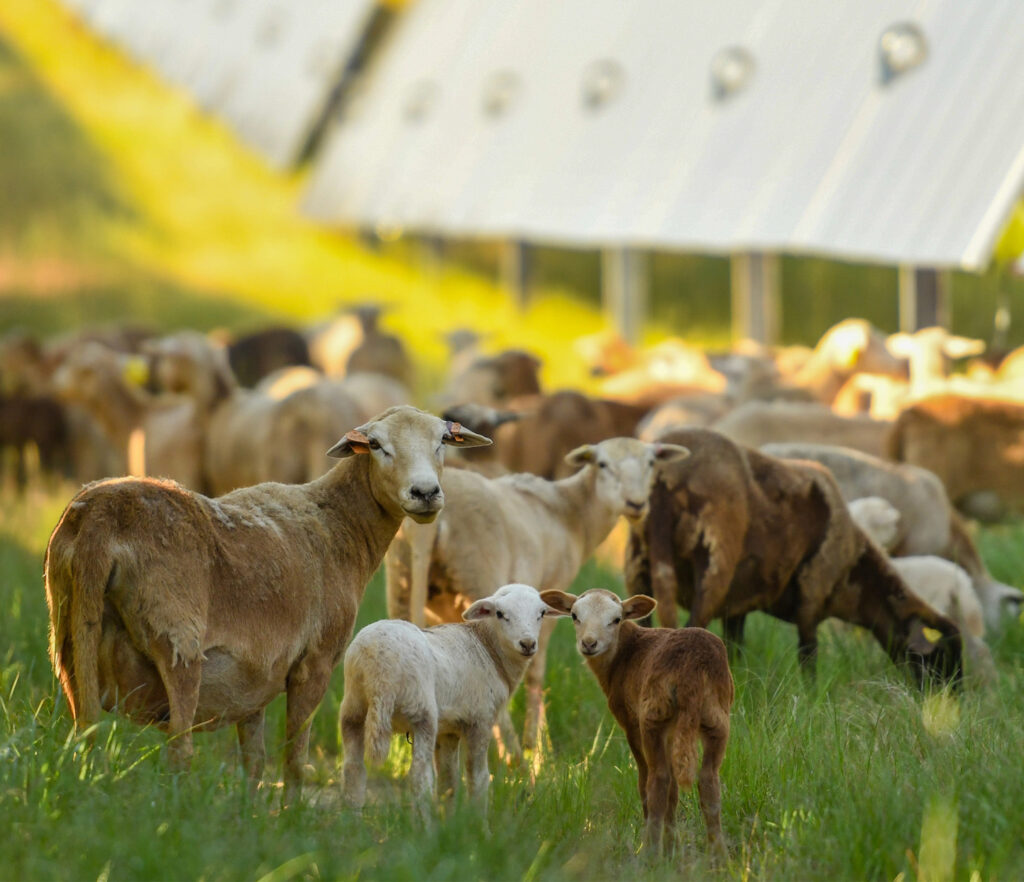
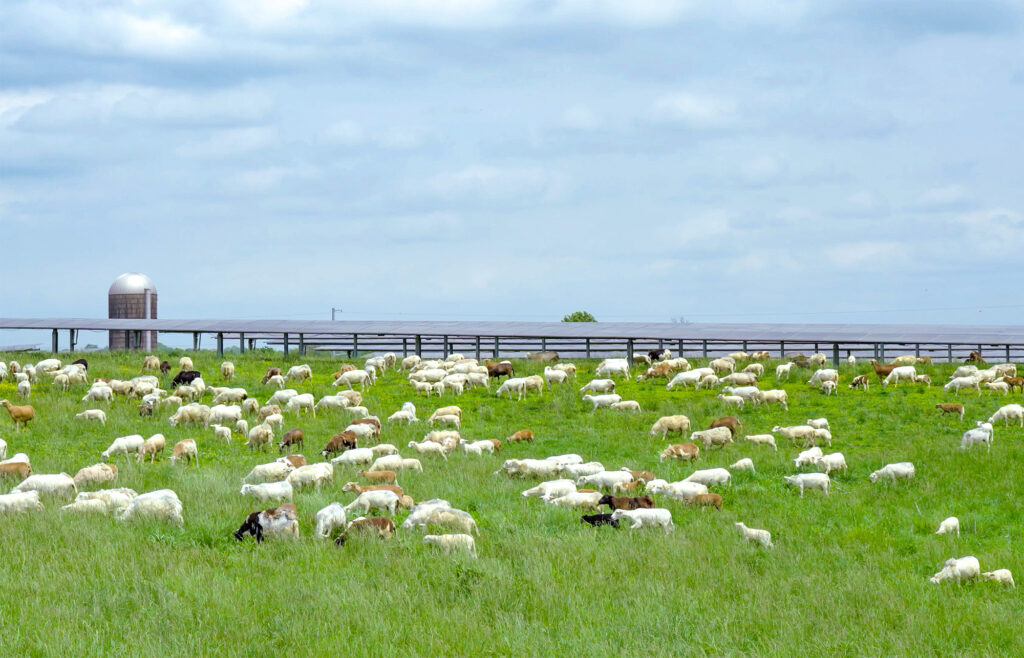
Our energy + ag projects provide access to land for local farmers and new revenue for both farmers and their suppliers. They also yield local pasture-raised meat, healthier soil, improved biodiversity, and happier livestock.
The panels provide the pasture-raised livestock with healthier forage as well as shade and protection from the elements—rain, hail, ice, and more.
Using the land for agricultural production protects it for the coming generations (unlike more permanent development, such as housing, a warehouse, or a manufacturing facility).
Our grazing management plans and protocols restrict animals from accessing waterways, following the USDA NRCS best practices.
Our solar projects are designed with reliability and the highest performance in mind over their 40- year useful lifetimes. This 40-year view means we design the entire plant and select equipment to last at least 40 years. Unlike some developers who may focus more on meeting minimum design criteria to reduce short-term costs, Silicon Ranch places more emphasis on reliability and the requirements of long-term ownership.
At the end of 40 years, our projects will either be repowered with new solar equipment or decommissioned. If a project is decommissioned, all system components will be removed, and the ground will be stabilized. All costs associated with the decommissioning process will be the responsibility of Silicon Ranch, not the community or local government. As Silicon Ranch will continue to own the property and will remain a member of the community, we are invested in ensuring that decommissioning will occur safely and responsibly, and that the site is in excellent condition.
Unlike virtually every other form of development, our land can be returned to other uses, including continued agricultural production, at the end of the energy facility’s useful life. After decommissioning, the land is an open pasture, now with increased fertility after 40 years of regenerative land management, ready for the next land use. A warehouse, manufacturing facility, or housing development cannot make this claim. That land is truly lost forever.
We are committed to leading industry advancements in responsible management of end-of-life solar equipment. Our commitment goes beyond recycling to repurposing, reusing, and fueling domestic manufacturing of solar panels for a circular solar economy.
To process-end-of life solar modules from Silicon Ranch projects, we have partnered with two pioneers in U.S.-based solar industry panel recycling. The first, SOLARCYCLE, offers an advanced platform that recovers approximately 95% of the value of solar panel materials, including glass and aluminum, as well as silicon, silver, copper, and aluminum. SOLARCYCLE recently opened a recycling facility in Cedartown, Georgia, where it can process approximately 10 million solar panels every year. The second, First Solar, recovers approximately 90 percent of materials. Recovered module materials are returned to the solar supply chain to help fuel the growing U.S. solar manufacturing industry with a domestic supply of materials essential to the production of new solar panels. For instance, recovered aluminum from the aluminum panel frames will be used to make aluminum frames for new solar panels.
Our industry leading recycling partnerships support our commitments to advance made-in-America solar manufacturing, a circular solar economy that reduces material use and recaptures “waste” as a resource to manufacture new panels, and economic development opportunities in communities across the country.
It is a misconception that ground-mounted solar farms decrease nearby home values.
Academic studies and appraisals examining sales prices of homes located in communities with solar farms in states across the U.S. show that utility-scale solar farms do not cause a decline in the value of neighboring properties, and in some cases may even have positive effects.
Solar farms are clean, quiet, low traffic, and safe. They provide significant tax revenues that can improve school district scores and do not pollute water or air. Solar projects do not present factors that are typically associated with a negative impact on property values, including noisy infrastructure (e.g., traffic, trains, airports), polluting infrastructure (e.g., busy roads, airports, oil and gas extraction), and cemeteries or funeral homes. Moreover, unlike other forms of development, land used for solar can be returned to other uses, including continuing to be in agricultural operations, at the end of the facility’s useful life. A warehouse, manufacturing facility, or housing development cannot make the same claim. That land is truly lost forever.
Silicon Ranch has commissioned matched-pair analyses in multiple states. These analyses compare nearly identical homes except for proximity to a solar farm, isolating the effect of the project. These analyses yield conclusions similar to the following conclusion from one recent Georgia appraisal, performed by a licensed third-party appraiser:
“Based on the data and analysis in this report, it is our professional opinion that the existing solar farm has no discernible impact on the value of adjoining, abutting, or otherwise nearby properties and that the use is in harmony with the area in which it is located.”
Yes, our projects follow and adhere to all local, state, and federal regulations, including fencing, electric codes, and signage regulations. Additionally, Silicon Ranch projects are monitored 24/7 so that any disturbance to the system can be quickly and safely acted upon.
Silicon Ranch never broadcast sprays herbicides or pesticides. We also refrain from spot spraying pesticides at our projects, unless required by state law where a project is located to mitigate noxious weeds determined injurious to agricultural or horticultural crops or, in some instances, to prevent small targeted amounts of vegetation from growing up into equipment that would interfere with solar generation and impede the facility’s ability to deliver power to serve homes and businesses in the long-term. When circumstances require that we use pesticides, Silicon Ranch is committed to minimizing their use, meaning that we only spot spray EPA approved herbicides—which are commonly used on timber farms—when required. We recognize that our responsibility as a good neighbor doesn’t stop at our fence line. Rather than viewing the land housing our solar projects as a liability, we recognize that land and vegetation are valuable natural resources and biological assets. When land and vegetation are managed properly, and in alignment with natural systems, we can revitalize soils, restore grassland ecosystems, increase biodiversity, sequester carbon, improve water quality, and build better solar facilities. Ultimately, through our Regenerative Energy approach, our goal is to leave the land better than we found it.
In summary, Silicon Ranch never uses vegetative growth inhibitors, nor do we blanket spray our sites with broad spectrum, non-selective herbicides. Herbicide use is limited to spot spraying of noxious weeds determined harmful to agricultural or horticultural crops and targeted spraying around inverter and transformer pads and the substation.
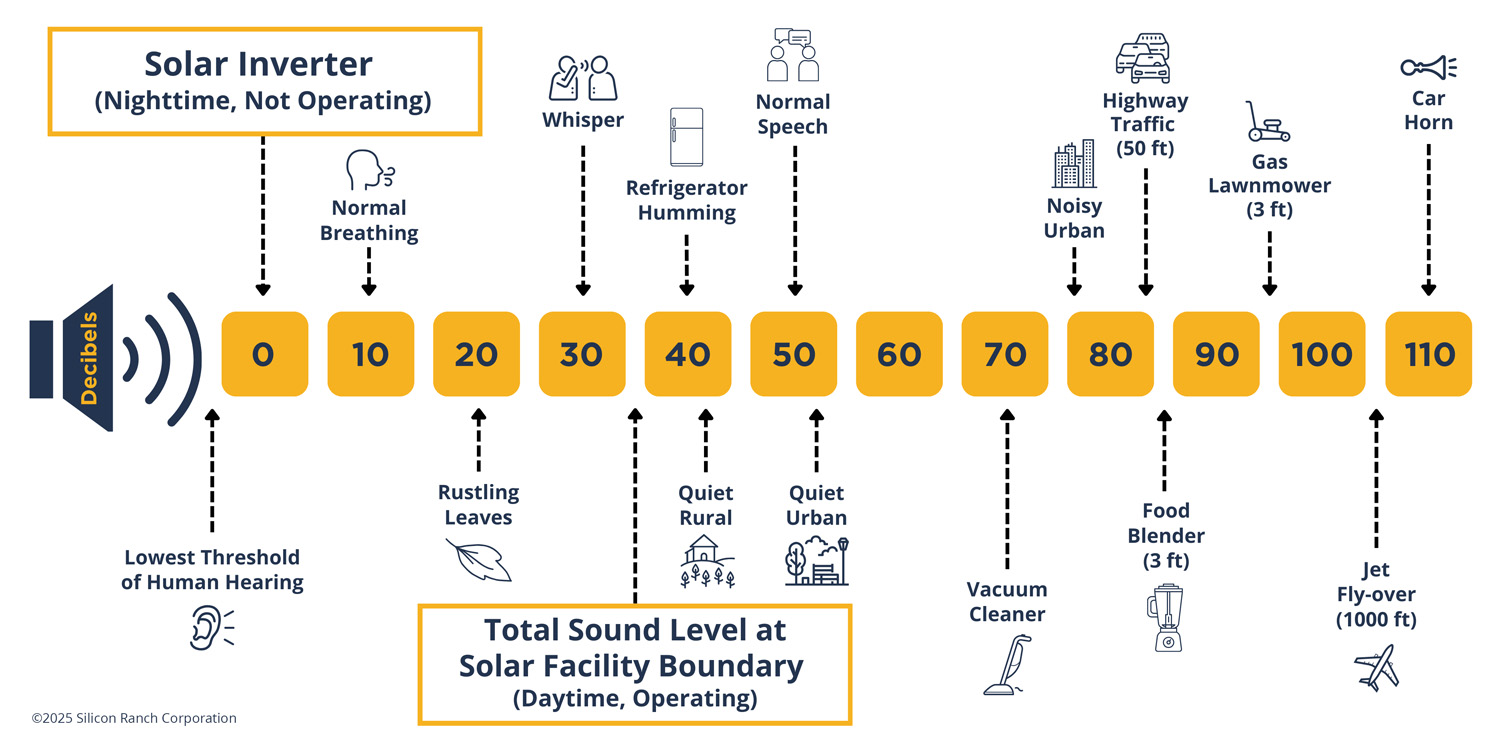
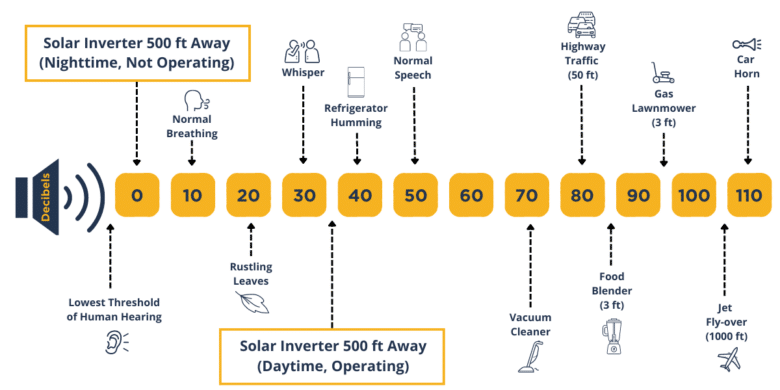
Once operational, our projects do not generate any noise that can be heard outside the facility fencing. The inverters have a quiet hum, not unlike that heard from a residential transformer, the small green electrical box in the neighborhood. Given compliance with required project setbacks from property boundaries and the location of the inverters within the fenced area of our projects the sounds from the project are imperceptible.
A solar farm is a collection of interconnected solar panels that are strategically placed to maximize their ability to capture sunlight and convert it to electricity. Sunlight contains little packets of energy called photons. When photons from the sun reach the solar panels, it causes energy electrons within those panels to move and in turn create an electrical current. That electric current is then sent to an inverter which converts it from DC to AC. That power is then pushed out from the solar site onto the transmission lines where the electricity is then distributed to households and businesses.
Once operational, our projects do not generate any noise that can be heard outside the facility fencing. The inverters have a quiet hum, not unlike that heard from a residential transformer. We typically have 60’-40’ setbacks around the exterior of the site, with a 100’ setback from the interior parcel. Given the location of the inverters within the fenced array, sounds from these projects are imperceptible.
Solar modules do not cause glare in houses because modules are designed to absorb (rather than reflect) as much light as possible and are covered with a protective layer of anti-reflective matte glass.
No. Responsible solar development can actually enhance, not harm, wildlife habitat.
Silicon Ranch’s approach to land management has demonstrated that responsible solar development can improve wildlife habitat. For instance, we have seen a measurable increase in bobwhite quail populations at our Hazlehurst projects in Jeff Davis County, where the previous regime of intensive tillage and herbicide use for cotton-peanut-corn farms damaged bobwhite quail populations over the past 80 years. With a transition to zero soil disturbance after construction, perennial vegetation, and properly timed mowing events, these solar projects create ground nesting bird habitat where bobwhite quail and other wildlife thrive. These healthy populations then spill over into adjacent hunting properties, where neighbors share in the benefit of this work.
In addition, Silicon Ranch has developed and funded a private Gopher Tortoise Sanctuary in partnership with Georgia Department of Natural Resources on the company’s privately owned lands in Clay County. Working together, Silicon Ranch and the Department have relocated several tortoises from surrounding projects, and have room for more. In Lee County, Silicon Ranch intentionally designed in wildlife corridors at the DeSoto project site.
Silicon Ranch takes wildlife habitat very seriously, and our investment in this sanctuary and these wildlife corridors is testament.
Our Regenerative Energy platform is an outcome driven, third-party verified holistic standard of excellence for the design, construction, and operation of solar farms.
For our ecological monitoring, we contract with Savory Institute Ecological Outcome Verification Professional Monitors to take soil samples and perform the short- and long-term ecological monitoring.
We measure and third-party verify our ecological outcomes using the Savory Institute’s Land to Market Ecological Outcome Verification assessment methodology, which was developed in collaboration with leading soil scientists, ecologists, agronomists, and an extensive network of regenerative land managers around the world. This methodology measures the health of the land as a living system. In 2022, the Savory Institute certified land housing seven Silicon Ranch solar facilities as ‘regenerative’.
If we conduct a soil carbon project at a site, we contract with Earth Optics to measure soil carbon. The soil is also tested at four laboratories, including one for agriculture analysis, during our Geotechnical testing prior to construction.