
Recent studies from Tennessee, North Carolina, and Georgia find that solar energy development is expected to occupy a minimal amount of farmland and can provide community benefits that other forms of development can’t offer
Questions about solar energy development and land use are being raised across the United States, with a particular focus on large-scale solar’s impact on existing farmland and local agriculture economies in rural areas. In response, states, universities, and non-profit research institutions[1] are studying these questions. Their key findings are consistent: Current and planned utility-scale solar projects (1) will occupy one percent or less of farmland in each state studied, (2) can keep land in agricultural production while improving land, soil health, and supporting rural communities, and (3) offers the opportunity to return the land to its original condition and purpose at end of life, versus more permanent development such as housing.
Residential real estate development has historically been and will likely remain the leading cause of farmland loss.
A 2023 Tennessee intergovernmental report concluded that even under strict assumptions, solar facilities are unlikely to be the primary driver of agricultural land loss in the coming decades in Tennessee. The report also determines that land hosting solar can likely be returned to agricultural production once the facility is decommissioned and all panels and other equipment have been removed.
The report found that even if all solar development that the Tennessee Valley Authority plans in its seven-state service area through 2035 were developed entirely in Tennessee and exclusively on farmland, solar would occupy approximately 100,000 acres, or 1% of farmland in the state. By comparison, in the twenty-year period from 1997-2017, 1,100,000 acres (9.3%)of farmland was converted to other uses, mainly residential.
More recently, the University of Georgia’s Carl Vinson Institute of Government published its report, Utility-Scale Solar Land Use in Georgia: 2025 Status Update, which asked, “how is the growth of large-scale solar energy impacting land use in Georgia?” and provided four primary and notable conclusions:
- Current and planned utility-scale solar in Georgia is estimated to occupy less than 0.2% of the state’s total land area, less than 0.15% of all Georgia farmland, and less than 0.3% of all forest land in the state.
- “Returning the land to its original condition [after solar] is a notable opportunity compared to more permanent development, such as housing.”
- “Some solar developers have made solar sites viable agribusiness operations,” where a single piece of land functions successfully as both a solar energy generation site and a profitable agricultural operation simultaneously, highlighting research that “…identifies potential community benefits, including maintaining or introducing agricultural uses on the land, reducing irrigation costs, providing backup power to farms, diversifying landowner income, and supporting various ecological functions.”
- Low-density residential development—not solar—is, and is projected to continue to be, the primary driver of land-cover change.
Land conversion in Georgia
Over the last fifty years, 4.6 million acres of Georgia’s forest and farmland were cleared or converted to another land cover and the state’s developed land grew by 2.9 million acres. Most of this development growth was “low-intensity development,” where impervious surfaces that can’t absorb water, such as smaller paved roads and single-family housing, account for 20% to 49% of the land. The report suggests that these changes are a result of the state’s significant population growth and the rising average age of farmers.
Land conversion to solar in Georgia
By contrast, the report estimates that at the upper bound, all operational and planned utility-scale solar would occupy a total of 66,000 acres out of Georgia’s total land mass of 37,000,000 acres, representing a maximum of less than 0.20%[2] of Georgia’s total land mass, less than 0.15%[3] of all the state’s farmland, less than 0.30% of all Georgia forest land, and just over 1% of the 4,600,000 acres of Georgia’s forest and farmland that have been cleared or converted to another land cover in the past 50 years.
Why solar development in Georgia
According to the institute’s report, over the next six years, Georgia Power projects up to 4,000 MW of new utility-scale solar or other renewables to contribute to a diverse mix of approximately 8,500 MW of new generation to meet growing customer demand by 2035. The authors of the report attribute the recent boom in solar development in the Peach State to several factors, “including improved cost-efficiency, policy incentives, energy market trends, demand from large-scale and residential customers, and generally shorter lead times for construction compared to other power generation sources.” As Georgia continues its rapid pace of economic growth accompanied by a generational rise in energy demand, and as utilities look to keep up with this consumer demand, these “shorter lead times for construction” have made solar an important ingredient in the state’s energy mix.
Methodology
To assess how the growth of solar’s role to meet the state’s growing demand for electricity will influence land use, the authors of the University of Georgia (UGA) report used the U.S. Energy Information Administration’s June 2025 interim report on operational photovoltaic solar developments and cross-checked its information with utility providers. They also engaged the UGA Warnell School of Forestry and Natural Resources to conduct an evaluation of land conversion to solar in Georgia between 2000 and 2024, and cross-checked the data with the United States Geological Survey’s U.S. Large-Scale Solar Photovoltaic Database.
Solar offers benefits that other forms of development don’t offer
While every acre of farmland is important, this report shows that solar development accounts for a negligible share of farmland conversion in Georgia—even under the most expansive estimates. Moreover, unlike other more permanent forms of development, solar does not necessarily mean a permanent loss of agricultural land. As the report notes:
“The likelihood that farmland or forest land would be converted to other uses, such as housing, is an important consideration… Historically, declining returns led many farm and forest landowners to sell their property for residential or commercial development… Returning the land to its original condition [after solar] is a notable opportunity compared to more permanent development, such as housing.”
The report also highlights that, in some cases, solar development has helped enhance rather than displace agricultural opportunities in Georgia, demonstrating that solar projects do not necessarily prevent land from remaining, or even becoming, active farmland:
“Some solar developers have made solar sites a viable agribusiness operations. Research identifies potential benefits, including maintaining or introducing agricultural uses on the land, reducing irrigation costs, providing backup power to farms, diversifying landowner income, and supporting various ecological functions.”
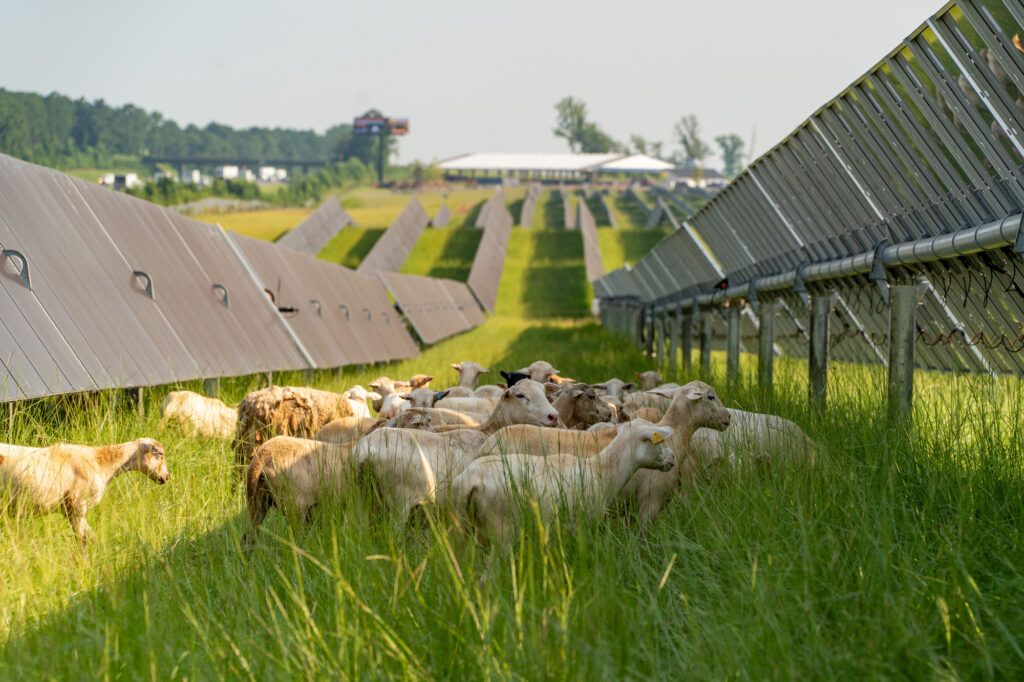
In Georgia, Silicon Ranch has proven that solar development and agriculture can be practiced together on the same land in ways that are good for the land, good for the animal, good for energy generation, and good for the career prospects of aspiring farmers with no inherited land on which to work. This practice is called “agrivoltaics,” and Silicon Ranch’s leading role in its deployment across Georgia is acknowledged explicitly by the authors of this report:
Silicon Ranch partners with local farmers and ranchers, such as White Oak Pastures in Bluffton, and it directly employs shepherds and ranch hands from local communities and institutions such as Abraham Baldwin Agricultural College in Tifton.
Our company-owned flock of sheep accounts for 11% of the overall Georgia flock, and our flagship Houston Solar Project in Elko, Georgia, is home to our genetic improvement flock. At this site, our shepherds work with world-leading sheep geneticists to develop a strain of Katahdin sheep uniquely suited to life in the climate and ecology of Georgia and the Southeast. Learn more about how Silicon Ranch is pairing energy generation with regenerative livestock grazing, all while helping the next generation of Georgia farmers build their skills and experience here, here, and here.
[1] A 2022 analysis from the North Carolina Sustainable Energy Society found that utility-scale photovoltaic systems occupy less than 1% of the state’s agricultural land even as North Carolina ranks 5th in the nation for total solar installed.
Only 0.28% of agricultural land and 0.12% of the total land area of the state are developed with solar panels
Solar occupies ~30,000 acres of the state’s ~11,000,000 acres used for agriculture—defined as cultivated cropland, evergreen forest, or pasture/hay.
[2] 0.18%
[3] 0.29%