
Bacon County Energy + Agriculture Project: Powering Rural Georgia and Supporting Its Farmers

With Silicon Ranch, It’s Energy and Agriculture, Not Energy or Agriculture

Silicon Ranch is planning a three-phase energy plus agriculture project in Bacon County. This made-in-America energy project is needed to produce vital electricity to support Georgia’s electric cooperatives, including the local cooperative Satilla REMC, that power rural Georgia homes and to bolster the resiliency of the local grid. It will keep the land in agricultural production, protecting it for the coming generations. The project will provide access to land for local farmers and new revenue for both farmers and their suppliers, create new long-term ranching positions, and yield locally raised grass-fed meat and healthier soil. At the end of its useful life, the project will be repowered or decommissioned. If decommissioned, after decades of being managed regeneratively, the land will be among the most fertile in the state.

This project also brings two funds that total $2.5 million in direct community support to Bacon County over the next 25 years: a $1.25 million College Scholarship Fund to fund scholarships for Bacon County students pursuing college, technical training, or skilled trades, and a $1.25 million Conservation Stewardship Fund to improve parks, ballfields, and outdoor spaces for hunting, fishing, and recreation.

Have questions? Click here for responses to questions or concerns we have received from Bacon County community members and for more information about Silicon Ranch, the Bacon County Energy+Ag Project, and our wholly owned agribusiness, Regenerative Energy®.

Projects that combine solar energy production and agriculture on one piece of land, with crops or livestock being raised underneath or between the panels, are called agrivoltaics projects. Silicon Ranch is the industry leader in grazing agrivoltaics projects through our wholly owned agribusiness, Regenerative Energy®. We own one of the largest sheep flocks in the Southeastern U.S., employ a team of shepherds, and are working to scale cattle grazing and solar energy production on the same land that is good for solar generation, good for the land, and good for the animal through our patented CattleTracker™ system.

The Bacon Energy+Ag Project will have positive economic, social, and land use impacts that will benefit Bacon County for the long-term.

Equivalent of Georgia Homes Powered Annually by the Bacon County Energy+Ag Project

50,000

Reliable, Made-in USA Energy Generated

300 Megawatts

Construction Jobs that Build a Skilled Workforce for Georgia’s Growing 21st Century Economy

1,000+

Scholarship Fund to Support Bacon County Youth ($50,000 per year for 25 years)

$1,250,000

Scholarship Fund to Support Bacon County Youth ($50,000 per year for 25 years)

$1,250,000

New Tax Revenues over 40 Years to Fund Schools and Public Services

$45,000,000+

Capital Investment for Local Economic Growth

$300,000,0000

Equivalent of Georgia Homes Powered Annually by the Bacon County Energy+Ag Project

50,000

Reliable, Made-in USA Energy Generated

300 Megawatts

Construction Jobs that Build a Skilled Workforce for Georgia’s Growing 21st Century Economy

1,000+

Scholarship Fund to Support Bacon County Youth ($50,000 per year for 25 years)

$1,250,000

Conservation Stewardship Fund to Support Outdoor Recreational Initiatives ($50,000 per year for 25 years)

$1,250,000

New Tax Revenues over 40 Years to Fund Schools and Public Services

$45,000,000+

Capital Investment for Local Economic Growth

$300,000,000

Photo courtesy of Nextpower

Bolsters American Manufacturing

The company will build the project using made-in-America solar panels and trackers, bolstering U.S. manufacturing. Learn more about our long-term commitment to domestic manufacturing.

Keeps Land in Regenerative Agricultural Production

Silicon Ranch will keep the land housing the project in agricultural production through our wholly owned agribusiness, Regenerative Energy®. Using regeneratively managed sheep, we will protect and improve soil health and wildlife and provide new opportunities for farmers and their families.

Meet Regenerative Energy, Our Company-Owned Agribusiness

Silicon Ranch launched Regenerative Energy® in 2019, and since then Georgia has become the heart of our agrivoltaics platform, which co-locates regenerative agriculture with energy production to revitalize ecosystems–making our communities healthier. Regenerative Energy is in large part a result of a conversation—that resulted in a long-term partnership—with world-renowned regenerative rancher and Georgia’s own Will Harris of White Oak Pastures.

Over the past four years, we have implemented a number of firsts in Georgia through Regenerative Energy, including being the first US solar developer to acquire and manage a company-owned flock of sheep.

To grow our company flock responsibly, we constructed a state-of-the-art lambing barn at our Houston Solar Project in Houston County, Georgia, built a team of in-house shepherds and world-leading sheep geneticists, and partnered with the National Sheep Improvement Program to help strengthen not only our flock but the entire national flock as well. Click here to learn more about this happy marriage of tradition and innovation.

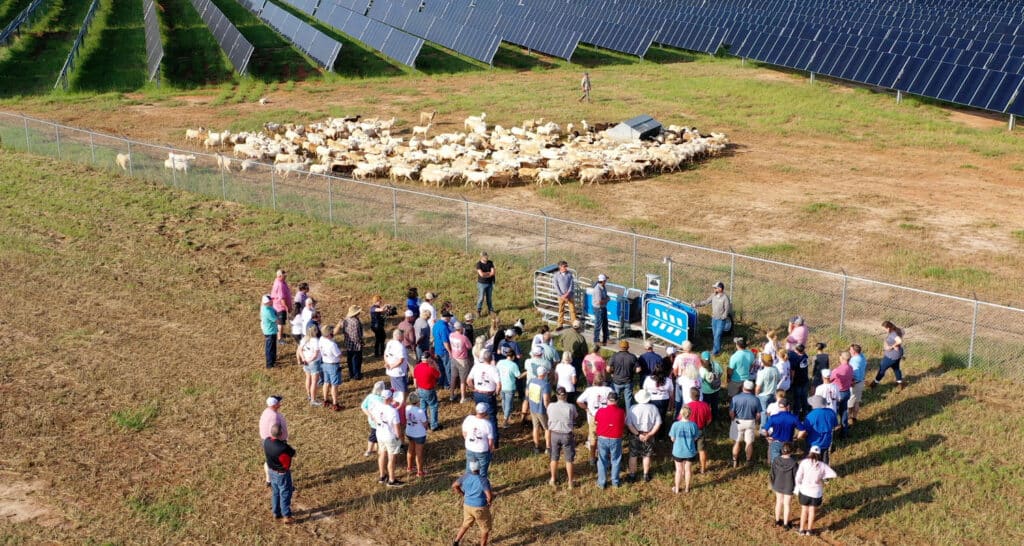
Foreground: Silicon Ranch Regenerative Energy® team hosting Georgia Young Farmers Association members at Houston Solar Farm to educate them on the benefits and career opportunities resulting from marrying solar energy production with regenerative agriculture and land management. At back: Agrivoltaic Technician Jack Mason works the sheep with his border collie, Callie, during a shepherding demonstration.

What sets Silicon Ranch apart is that we own our projects and the land they occupy. As the long-term owner and operator, we invest in communities. We partner with and support educational, agricultural, and other institutions through workforce development and career fairs, site tours, scholarships, charitable contributions, research projects, and more.

We want to hear from you!

Silicon Ranch Responses to Bacon County Community Questions and Concerns

For many communities, solar projects are new. We completely understand why you might have questions. In fact, we hope you do have them and are able to ask us about them in person, via email, or at the form on this page. We have already received a number of questions and concerns about this energy project and what it will mean for Bacon County. You can read those questions and our responses to them in this section and in this document here.

Community Question:

“Are you or have you hired locals for your project? Where are job postings for these? Who will be over maintenance? When will these jobs be available? Who controls your mowing contract? Where was these bid for these jobs?” 

Response:

Yes, we will have opportunities for locals to be employed throughout the construction of the project and its operations. Even though we are still very early in the construction phase, we are already working with several regional vendors, and will have more as the project progresses.  

The construction of all three phases of this project will create more than 1000 construction jobs to build the project. Once the project is built, we will hire 7 full-time employees to operate the project and an additional team of local farmers to manage the vegetation through rotational grazing with the site’s resident flock of sheep.  

As we get closer to construction, we will work with our subcontractors to host job fairs in the county.  

We will give a preference to the local labor pool and the military veteran community to fill these roles, further distributing the positive economic impact of our solar farm in your community.  

FWIW, you may also be interested in the American jobs you don’t think about when you look at one of our projects. Domestic Manufacturing and Americans across the country, especially here in the Southeast who produce the equipment we use on our projects, benefit from these projects. We’re proud to power this project with American-made equipment, supporting domestic jobs, strengthening domestic manufacturing, and advancing energy independence.  

You can read more about our commitment to domestic manufacturing, and how we’re using our purchasing power to help reshore American jobs for more secure American Energy, here.

Community Question:

“I’m not being rude or unsupportive…. Just trying to understand….Can you come to the next county meeting in Bacon county and explain why this company was sued for water contamination? And how this isn’t dangerous to the land and environment?”

Response:

Understood. Thank you so much for reaching out with your excellent questions here. 

Any chance there is to be a part of the local conversation, or answer any questions around this project and the benefits to Bacon County that accompany it, we plan to be a part of.  

Our goal at Silicon Ranch is to leave the land better than when we initially find it. 

During operation, we nurture the land using regenerative land management practices that promote long-term, deep-rooted vegetation, including pollinator habitat, and faster plant growth cycles. This approach, which we implement under our Regenerative Energy platform, not only multiplies the typical beneficial outcomes of a solar project but also creates new benefits. These include healing degraded soils, improving ecosystem function and water quality, decreasing erosion and runoff, and increasing biodiversity of both plants and wildlife, among others. 

Regenerative Energy agrivoltaics is a subset of our Regenerative Energy platform that marries regenerative agriculture production with energy production. Silicon Ranch debuted agrivoltaics to fulfill our commitment to being a good steward of the land in 2019 at our 121-acre Providence Solar Farm in Madison County, Tennessee. We returned the long-time conventional cotton and grain farm to agricultural production with the introduction of 500 sheep that are intentionally managed to heal the land, using the adaptive multi-paddock grazing approach. 

Since then, we have expanded our use of Regenerative Energy agrivoltaics to thousands of acres and have become the committed owners of a large and growing flock of thousands of sheep that is restoring company-owned solar farmland. This endeavor provides regenerative land management training and full-time employment to staff from diverse backgrounds, including local community members, adults right out of high school, over the road truckers, a pharmacy technician, and a farmer, with joint goals of restoring company-owned land and allowing this and future generations to stay in their home communities. 

As for your question on the lawsuit, in 2023, a jury in Stewart County GA, found that Silicon Ranch and our contractor, IEA, failed to implement and maintain proper erosion and sediment control measures which resulted in sedimentation leaving the Lumpkin solar site and accumulating in a neighbor’s pond in Stewart County, Georgia. The jury awarded the plaintiffs $135.5 million in total damages. While the initial judgment was covered extensively by local and national media due to the sensational amount of damages awarded by the jury, there was less media coverage of what followed. Shortly after the trial, the $135.5 million judgment was overturned by the judge and reduced by almost 97%. Following that ruling by the judge, the parties reached a mutual settlement of the lawsuit, and the litigation was dismissed.  

Although it was an incredibly challenging situation, Silicon Ranch is a better company because of the Lumpkin project experience. We learned important lessons from the issues we had on site with both the design of the erosion and sediment control plan as well as its implementation, and those lessons have been incorporated into how we develop projects today and how we hold our contractors accountable. Equally important, as a long-term asset owner and member of the Stewart County community, we never wavered in our commitment to fix the issue and make things right. Today, in addition to generating affordable, renewable energy and contributing significant tax revenue to Stewart County and supporting more than a dozen charitable causes throughout Stewart and neighboring counties, the Lumpkin site hosts a flock of more than 1000 sheep, owned and managed by a local ranching family. One of our company values is that we take the right path over the easier path, and while the situation with Lumpkin was challenging, we do believe we made it right. We are immensely proud of what our team has achieved with the site and encourage anyone who has questions about this case to come see it for themselves. 

Silicon Ranch looks forward to continuing the important work that we do in Stewart County, throughout the state of Georgia, and across the United States to help make communities stronger, healthier, and more resilient, all while investing in energy infrastructure, revitalizing domestic manufacturing, and bolstering new agricultural and conservation opportunities in rural America. 

Community Concern:

“Our community is opposed to this as is our current president Donald J Trump. This is a waste of prime agricultural property. Putting Sheep on the land doesn’t negate the harm done to the ecosystem in the area. Neither do I want to find further project monies to a China manufacturer. The cost to the environment to produce these panels is unmanageable the emissions, the mining of the raw materials and as you are aware they contain chemicals cadmium that are toxic. They simply are not worth it. Stop using our communities as experiments for fake climate change agendas to make your money.

Response:

Thank you so much for reaching out. Almost every aspect of daily life relies on energy in some way or another, especially the homes, businesses and family farms here in rural Georgia. We support an all-of-the-above energy mix, but it’s important to recognize that not all forms of generation can be delivered at the speed or within the budget demanded today. That said, our company is a fully integrated provider of customized solar energy solutions, which is cost competitive with the lowest-cost forms of new energy and by far the fastest to bring online. In fact, solar can be deployed in a fraction of the time it takes to bring a nuclear facility online. Other benefits from our projects include: 

American Workers 
Domestic Manufacturing and Americans across the country, especially here in the Southeast, who produce our equipment benefit. We’re proud to power this project with American-made equipment, supporting domestic jobs, strengthening domestic manufacturing, and advancing energy independence.  

Rural Georgia receives much needed energy 
There are many benefits to our Solar+Ag projects, starting with the fact that our projects require no up-front capital from customers or the communities where facilities are located, while helping strengthen the local grid and provide much needed power to Georgia.  

Local Farmers and Ranchers 
Local farmers and the local businesses they count on, benefit by having new access to land to graze livestock. We keep project land in agricultural production through Regenerative Energy®, partnering with local farmers to graze sheep under solar panels. By providing access to land for local ranchers, our projects have enabled family farms and aspiring farmers with new opportunities—and like-wise local businesses that support them—here in the region to grow, or even start, their operations. 

The Land and Wildlife 
As a result of our approach to land stewardship, the soil at our projects benefits. As a long-term landowner, we recognize that land and vegetation are valuable natural resources and biological assets. When land and vegetation are managed properly, and in alignment with natural systems, we can revitalize soils, restore grassland ecosystems, increase biodiversity, sequester carbon, improve water quality, and build better solar facilities. Ultimately, through our Regenerative Energy approach, our goal is to leave the land better than we found it. 

$45 Million+ in New Tax Revenue for Bacon County 
Because Silicon Ranch becomes a property owner and taxpayer in the community, our projects generate significant new tax revenues for local communities. Here in Bacon County this project represents more than $45 million+ in new tax revenue for the local community to be applied to local priorities. Since it’s $45 million+ in new tax revenue that we would be paying locally—as the owner of the project—that list of priorities would be up to the local community to decide. It could include government services (like the police or fire department), infrastructure projects, and schools including the gymnasium. 

The American made panels we use contain only materials in solid-state form, just like the electronic components in laptops and smartphones. These panels do not contain liquids that can leak. The thin layers of cadmium telluride (CdTe) in these panels are stable and solid (high boiling point, low vapor pressure, low solubility) and are encapsulated between thick layers of glass. This encapsulation prevents CdTe from escaping into the surrounding environment, mixing with soil or water, or vaporizing into the air. Thin film CdTe solar panels are made of tempered glass and pass rigorous hail and other weather testing, as well as the U.S. EPA’s Toxicity Characteristic Leaching Procedure test. This test is designed to assess the potential for long-term leaching of products disposed of in landfills. 

At the end of 40 years, our projects will either be repowered with new solar equipment or decommissioned. If a project is decommissioned, all system components will be removed, and the ground will be stabilized. All costs associated with the decommissioning process will be the responsibility of Silicon Ranch, not the community or local government. As Silicon Ranch will continue to own the property and will remain a member of the community, we are invested in ensuring that decommissioning will occur safely and responsibly, and that the site is in excellent condition to be used for whatever agricultural purpose desired, whether that be potatoes or blueberries. 

Our ability to return the land as good as—if not better than—when we find it, is due partly to the fact that we keep project land in agricultural production through Regenerative Energy®, partnering with local farmers to graze sheep under solar panels. It supports soil health, protects wildlife, and provides shade and an element of protection for the animals. Please let me know if you have any other concerns or questions, I can help you answer. 

Community Question:

“To Silicon Ranch and all parties involved in Bacon County: When a Silicon Ranch–owned solar site reaches the end of its life, what is the long-term plan for that land? 

Does it return to farming or forest, or is it open to future development? And are there any legally binding deed restrictions or permanent land-use protections in place after decommissioning—and if so, can that documentation be provided for public review?”

Response:

Our projects are all underwritten to a 40-year useful life, and at the of that term, our projects will either be repowered with new solar equipment—it’s highly likely that we will need more power in 40 years than we do today—or decommissioned. If a project is decommissioned, all system components will be removed, recycled, and/or repurposed. Our piles are driven straight into the soil rather than anchored in concrete, and they can be plucked out of the ground, and the steel can be reused. Same for the panels. All costs associated with the decommissioning process will be the responsibility of Silicon Ranch, not the community or local government. As Silicon Ranch will continue to own the property and will remain a member of the community, we are invested in ensuring that decommissioning will occur safely and responsibly, and that the site remains in excellent condition. 

As we’ve discussed, our ability to return the land as good as—if not better than—when we find it, is due partly to the fact that we keep project land in agricultural production through Regenerative Energy®, either through our own in-house team of shepherds or by partnering with local farmers to graze sheep under solar panels. It supports soil health, protects wildlife, and provides shade and an element of protection for the animals. 

As for the equipment itself, we are committed to leading industry advancements in responsible management of end-of-life solar equipment. Our commitment goes beyond recycling to repurposing, reusing, and fueling domestic manufacturing of solar panels for a circular solar economy.  

To process-end-of life solar modules from Silicon Ranch projects, we have partnered with two pioneers in U.S.-based solar industry panel recycling. The first, SOLARCYCLE, offers an advanced platform that recovers approximately 95% of the value of solar panel materials, including glass and aluminum, as well as silicon, silver, copper, and aluminum. The second, First Solar, recovers approximately 90 percent of materials. Recovered module materials are returned to the solar supply chain to help fuel the growing U.S. solar manufacturing industry with a domestic supply of materials essential to the production of new solar panels. For instance, recovered aluminum from the aluminum panel frames will be used to make aluminum frames for new solar panels.  

Our industry leading recycling partnerships support our commitments to advance made-in-America solar manufacturing, a circular solar economy that reduces material use and recaptures “waste” as a resource to manufacture new panels, and economic development opportunities in communities across the country. 

As for your last question, I’m not exactly sure what you are asking, but no deed or land use restrictions will follow the property and limit the post-solar uses for the land. As discussed earlier, it can return to any uses we or future owners desire at the time. We will have a security bond in place and decommissioning plan on file with the county that will allow the county to enforce the decommissioning and removal obligations we have publicly committed to in our decommissioning plan. 

Again, unlike virtually every other form of development, our land can be returned to other uses, including continuing to be in agricultural production, at the end of the energy facility’s useful life. After decommissioning, the result is an open pasture, now with increased fertility after 40 years of regenerative grazing, ready for the next land use. A warehouse, manufacturing facility, or housing development cannot make this claim; that land is truly lost forever. 

Community Comment:

Need y’all to hire me as a supervisor.”

Response:

Thank you for reaching out with interest in working with Silicon Ranch. It would be great if you could share a little more about the types of roles you are interested in and what your skillsets are.

Silicon Ranch Responses to Bacon County Community Questions and Concerns

For many communities, solar projects are new. We completely understand why you might have questions. In fact, we hope you do have them and are able to ask us about them in person, via email, or at form on this page. We have already received a number of questions and concerns about this energy project and what it will mean for Bacon County. You can read those questions and our responses to them here.

COMMUNITY CONCERN: Our community is opposed to this as is our current president Donald J Trump. This is a waste of prime agricultural property. Putting Sheep on the land doesn’t negate the harm done to the ecosystem in the area. Neither do I want to find further project monies to a China manufacturer. The cost to the environment to produce these panels is unmanageable the emissions, the mining of the raw materials and as you are aware they contain chemicals cadmium that are toxic. They simply are not worth it. Stop using our communities as experiments for fake climate change agendas to make your money. 

Response:

Thank you so much for reaching out. Almost every aspect of daily life relies on energy in some way or another, especially the homes, businesses and family farms here in rural Georgia. We support an all-of-the-above energy mix, but it’s important to recognize that not all forms of generation can be delivered at the speed or within the budget demanded today. That said, our company is a fully integrated provider of customized solar energy solutions, which is cost competitive with the lowest-cost forms of new energy and by far the fastest to bring online. In fact, solar can be deployed in a fraction of the time it takes to bring a nuclear facility online. Other benefits from our projects include: 

American Workers 
Domestic Manufacturing and Americans across the country, especially here in the Southeast, who produce our equipment benefit. We’re proud to power this project with American-made equipment, supporting domestic jobs, strengthening domestic manufacturing, and advancing energy independence.  

Rural Georgia receives much needed energy 
There are many benefits to our Solar+Ag projects, starting with the fact that our projects require no up-front capital from customers or the communities where facilities are located, while helping strengthen the local grid and provide much needed power to Georgia.  

Local Farmers and Ranchers 
Local farmers and the local businesses they count on, benefit by having new access to land to graze livestock. We keep project land in agricultural production through Regenerative Energy®, partnering with local farmers to graze sheep under solar panels. By providing access to land for local ranchers, our projects have enabled family farms and aspiring farmers with new opportunities—and like-wise local businesses that support them—here in the region to grow, or even start, their operations. 

The Land and Wildlife 
As a result of our approach to land stewardship, the soil at our projects benefits. As a long-term landowner, we recognize that land and vegetation are valuable natural resources and biological assets. When land and vegetation are managed properly, and in alignment with natural systems, we can revitalize soils, restore grassland ecosystems, increase biodiversity, sequester carbon, improve water quality, and build better solar facilities. Ultimately, through our Regenerative Energy approach, our goal is to leave the land better than we found it. 

$45 Million in New Tax Revenue for Bacon County 
Because Silicon Ranch becomes a property owner and taxpayer in the community, our projects generate significant new tax revenues for local communities. Here in Bacon County this project represents more than $45 million in new tax revenue for the local community to be applied to local priorities. Since it’s $45 million in new tax revenue that we would be paying locally—as the owner of the project—that list of priorities would be up to the local community to decide. It could include government services (like the police or fire department), infrastructure projects, and schools including the gymnasium. 

The American made panels we use contain only materials in solid-state form, just like the electronic components in laptops and smartphones. These panels do not contain liquids that can leak. The thin layers of cadmium telluride (CdTe) in these panels are stable and solid (high boiling point, low vapor pressure, low solubility) and are encapsulated between thick layers of glass. This encapsulation prevents CdTe from escaping into the surrounding environment, mixing with soil or water, or vaporizing into the air. Thin film CdTe solar panels are made of tempered glass and pass rigorous hail and other weather testing, as well as the U.S. EPA’s Toxicity Characteristic Leaching Procedure test. This test is designed to assess the potential for long-term leaching of products disposed of in landfills. 

At the end of 40 years, our projects will either be repowered with new solar equipment or decommissioned. If a project is decommissioned, all system components will be removed, and the ground will be stabilized. All costs associated with the decommissioning process will be the responsibility of Silicon Ranch, not the community or local government. As Silicon Ranch will continue to own the property and will remain a member of the community, we are invested in ensuring that decommissioning will occur safely and responsibly, and that the site is in excellent condition to be used for whatever agricultural purpose desired, whether that be potatoes or blueberries. 

Our ability to return the land as good as—if not better than—when we find it, is due partly to the fact that we keep project land in agricultural production through Regenerative Energy®, partnering with local farmers to graze sheep under solar panels. It supports soil health, protects wildlife, and provides shade and an element of protection for the animals. Please let me know if you have any other concerns or questions, I can help you answer. 

It depends on the project, but typically projects interconnect to existing transmission lines adjacent to the property.

No. Silicon Ranch constructs photovoltaic facilities, which absorb solar energy rather than reflect it, and therefore do not heat up.

There are companies that place solar panels on top of warehouses, commercial buildings, and residential houses, but this is not what Silicon Ranch does. The first part to consider is location – utility scale solar plants need to be near a viable transmission or distribution line to allow for connection to the grid to prevent needing long, expensive transmission lines. Additionally, consolidating the solar plant into a concentrated location allows for more efficient and effective connection to the grid.

The second part to consider is the size – large warehouses tend to be between 500,000 and 1,000,000 square feet, which is approximately 12 – 24 acres. Silicon Ranch aims to build utility scale solar plants that require larger areas to generate the amount of energy necessary. Another factor is that not all existing buildings were designed or built to hold the structural load of a solar plant on the rooftops.

While there are companies that build solar plants on landfills, Silicon Ranch does not do so because building solar plants on landfills presents permitting and construction challenges, environmental challenges, such as avoiding damage to the landfill capping system, and engineering challenges, such as potential settlement of the landfill area that can lead to structural damage to the solar generating equipment.

We aim to deliver power into the communities that the power will serve. Each community has a range of siting options available, including both rooftop and ground mounted. In addition to questions of scale and structural stability, rooftop is by far the most expensive option for the installation of solar energy. Ground-mounted solar energy is the lowest cost form of new electricity generation in the United States today, and it is an important energy source for helping to keep rates low.

This will depend on the time of day, but generally, no more than ten feet high. The panels at many of our newer sites rotate to follow the sun throughout the day. At the beginning and end of the day, the solar panels will be at their highest as they will be angled 60 degrees. Around lunchtime, the panels will be at their lowest.

The supporting structures that hold the modules are designed to withstand wind loads of 105-120 mph.

We take intentional steps in our facility design, operations, and land management to ensure that stormwater runoff from each site will be reduced or not increased from the conditions that exist when we buy the property.

Most of our projects are proposed at sites where the existing land is agricultural, wooded, or a combination of both. Once a solar plant is constructed, impervious surfaces (foundation pads, equipment, gravel roadways, etc.) cover a relatively minor amount of the land housing it. So, while solar panels will be installed on the land, the stormwater will flow off the panels and across the vegetation, allowing for the water to infiltrate and evaporate or be absorbed and replenish the aquifer. Moreover, our regenerative land management practices increase vegetative cover and build soil organic matter and looser soils, leading to more water infiltration, increased water retention, and less stormwater runoff.

The reduction in stormwater runoff peak flow improves downstream flooding issues. Existing natural resources (e.g., wetlands, ponds, streams, floodplains, etc.) and associated buffer areas are field identified, delineated, reviewed by the appropriate agencies, and marked during construction to be protected. In some circumstances, it may be necessary to temporarily or permanently impact a natural resource to facilitate a crossing location (e.g., access road-stream crossing). In these situations, we secure all necessary permits and we implement associated mitigative measures.

With 23 projects in Georgia operating, under construction, or contracted, Silicon Ranch’s solar projects in Georgia create more than 6,500 construction jobs. We maintain a strong preference for hiring locally and from the military veteran community.

Once a project is approved, our Project Delivery team will work with local partners, such as the chamber of commerce, to develop a plan to engage qualified, local firms and invite them to bid on the project.

Make sure to go to the Contact Us page and fill out the Contact form for Vendors. A project representative will get back to you with more details on available work and the timing of proposals.

There are also periodic announcements regarding job fairs for local residents interested in working on these projects.

There is some truck and trailer traffic during the construction of projects, including 18-wheelers delivering supplies during installation. Prior to and throughout construction, Silicon Ranch coordinates with the community to provide a more precise operation schedule as the construction of a specific project approaches. Once operational, our sites are remotely monitored and rarely visited except for periodic and routine maintenance. This is usually accomplished with 1-2 pick-up trucks or vans, depending on the crew.

Yes, we always prefer to hire qualified, local firms when possible.

Silicon Ranch has a systematic approach to health and safety and is committed to the goal of zero recordable safety incidents. Accordingly, the team gives every consideration to safety and control measures as part of overall project design. In addition to his 25+ years of environmental, health and safety experience, Silicon Ranch’s Director of Environmental, Health, Safety, and Security—Jim Barfield, CSP, CHST—has deep credentials to lead the company’s approach to safety. Along with qualifications that include BSCP certifications, FEMA incident command, accident investigation, and OSHA 30 qualifications, he is a veteran of the United States Army as a Health Specialist of Preventative Medicine, where he educated personnel on pathogen exposure, disease and occupational illness prevention, enforced military regulations governing sanitary practice and industrial hygiene, and investigated and controlled sources of pathogen and toxin exposure both inside and outside of United States borders.

Our projects across Georgia follow and adhere to all local, state, and federal regulations including fencing, electric codes, and signage. Additionally, our projects will be monitored 24/7 so that any disturbance to the system can be quickly and safely acted upon.

Once construction commences, external to the site, we post appropriate warnings in traffic ways to alert drivers of impending truck entrances to the roadway. Internal to the site there are controls in place to regulate vehicles and heavy equipment on site.

The materials and components that comprise a solar energy generating facility are not hazardous to humans. Silicon Ranch prioritizes protection of the environment.

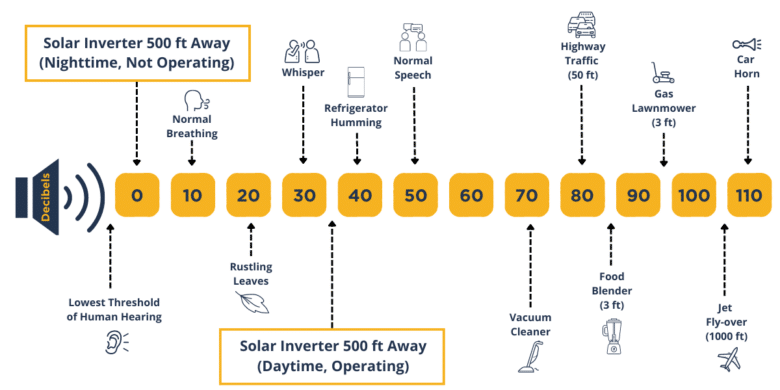
There is noise associated with the construction of projects, but Silicon Ranch seeks to minimize any potential disruption by limiting construction activities to normal business hours. Once operational, the sites do not generate appreciable noise. The inverters have a quiet hum when the plant is generating during daylight hours, but the noise is not audible beyond the property line. The inverters are typically located centrally on the project site, far enough away from neighboring houses to be imperceptible.

A solar farm is a collection of interconnected solar panels that are strategically placed to maximize their ability to capture sunlight and convert it to electricity. Sunlight contains little packets of energy called photons. When photons from the sun reach the solar panels, it causes energy electrons within those panels to move and in turn create an electrical current. That electric current is then sent to an inverter which converts it from DC to AC. That power is then pushed out from the solar site onto the transmission lines where the electricity is then distributed to households and businesses.

Once operational, our projects do not generate any noise that can be heard outside the facility fencing. The inverters have a quiet hum, not unlike that heard from a residential transformer. We typically have 60’-40’ setbacks around the exterior of the site, with a 100’ setback from the interior parcel. Given the location of the inverters within the fenced array, sounds from these projects are imperceptible.
Solar modules do not cause glare in houses because modules are designed to absorb (rather than reflect) as much light as possible and are covered with a protective layer of anti-reflective matte glass.

No. Responsible solar development can actually enhance, not harm, wildlife habitat.

Silicon Ranch’s approach to land management has demonstrated that responsible solar development can improve wildlife habitat. For instance, we have seen a measurable increase in bobwhite quail populations at our Hazlehurst projects in Jeff Davis County, where the previous regime of intensive tillage and herbicide use for cotton-peanut-corn farms damaged bobwhite quail populations over the past 80 years. With a transition to zero soil disturbance after construction, perennial vegetation, and properly timed mowing events, these solar projects create ground nesting bird habitat where bobwhite quail and other wildlife thrive. These healthy populations then spill over into adjacent hunting properties, where neighbors share in the benefit of this work.

In addition, Silicon Ranch has developed and funded a private Gopher Tortoise Sanctuary in partnership with Georgia Department of Natural Resources on the company’s privately owned lands in Clay County. Working together, Silicon Ranch and the Department have relocated several tortoises from surrounding projects, and have room for more. In Lee County, Silicon Ranch intentionally designed in wildlife corridors at the DeSoto project site.

Silicon Ranch takes wildlife habitat very seriously, and our investment in this sanctuary and these wildlife corridors is testament.

Our Regenerative Energy platform is an outcome driven, third-party verified holistic standard of excellence for the design, construction, and operation of solar farms.

For our ecological monitoring, we contract with Savory Institute Ecological Outcome Verification Professional Monitors to take soil samples and perform the short- and long-term ecological monitoring.

We measure and third-party verify our ecological outcomes using the Savory Institute’s Land to Market Ecological Outcome Verification assessment methodology, which was developed in collaboration with leading soil scientists, ecologists, agronomists, and an extensive network of regenerative land managers around the world. This methodology measures the health of the land as a living system. In 2022, the Savory Institute certified land housing seven Silicon Ranch solar facilities as ‘regenerative’.

If we conduct a soil carbon project at a site, we contract with Earth Optics to measure soil carbon. The soil is also tested at four laboratories, including one for agriculture analysis, during our Geotechnical testing prior to construction.

Yes, our projects follow and adhere to all local, state, and federal regulations including fencing, electric codes, and signage. Additionally, Silicon Ranch projects are monitored 24/7 so that any disturbance to the system can be quickly and safely acted upon.

With 23 projects in Georgia operating, under construction, or contracted, Silicon Ranch’s solar projects in Georgia create more than 6,500 jobs.

Our goal at Silicon Ranch is to leave the land as good, if not better, than when we initially find it.

During operation, we maintain the land using regenerative land management practices that promote long-term, deep-rooted vegetation and faster plant growth cycles. This approach, which we implement under our Regenerative Energy® platform, not only multiplies the typical beneficial outcomes of a solar project but also creates new benefits, including healing degraded soils, improving ecosystem function, and increasing biodiversity of both plants and wildlife, as well as pollinator habitat.  

Regenerative Energy came to be in large part as a result of an invitation from White Oak Pastures owner Will Harris to Silicon Ranch to visit his family’s world-renowned regenerative ranch in Bluffton. Harris introduced Silicon Ranch leadership to the methods of planned livestock grazing and other regenerative agricultural practices that his family had been deploying at White Oak Pastures for more than two decades. The result was a new partnership and Silicon Ranch’s innovative model for the solar industry, Regenerative Energy, our holistic approach to project design, construction, and land management that we now deploy across thousands of acres of land that we own and manage in the United States.


We recognize Georgia’s pride in the unique communities that make up the state and will implement the regenerative land management practices that are appropriate to each community to continue that legacy, in partnership with the local community and surrounding area.

Silicon Ranch aims to refrain from the use of any pesticides at our projects, unless required by state law where a project is located to mitigate noxious weeds determined injurious to agricultural or horticultural crops or, in some instances, to prevent small targeted amounts of vegetation from growing up into equipment that would interfere with plant performance and impede the facility’s ability to deliver power to serve homes and businesses in the long-term. When circumstances require that we use pesticides, Silicon Ranch is committed to minimizing their use, meaning that we only spot spray EPA approved herbicides – which are commonly used on timber farms – when required. We never broadcast spray herbicides or pesticides.

We recognize that our responsibility as a good neighbor doesn’t stop at our fence line. Rather than viewing the land housing our solar projects as a liability, we recognize that land and vegetation are valuable natural resources and biological assets. When land and vegetation are managed properly, and in alignment with natural systems, we can revitalize soils, restore grassland ecosystems, increase biodiversity, sequester carbon, improve water quality, and build better solar facilities. Ultimately, through our Regenerative Energy approach, our goal is to leave the land better than we found it.

We recognize Georgia’s pride in the unique ecosystems that make up the state and we are committed to designing, building, and operating our solar facilities in a way that continues that legacy, in partnership with communities throughout Georgia.

Our solar projects are designed with reliability and the highest performance in mind over their 40-year useful lifetimes. This 40-year view means we design the entire plant and select equipment to last up to 40 years. Unlike some developers who may focus more on meeting minimum design criteria to reduce short-term costs, Silicon Ranch places more emphasis on reliability and the requirements of long-term ownership.

At the end of 40 years, our Georgia projects will either be repowered with new solar equipment or decommissioned. If a project is decommissioned, all system components will be removed and the ground will be stabilized. All costs associated with the decommissioning process will be the responsibility of Silicon Ranch, not the community or local government. As Silicon Ranch will continue to own the property and will remain a member of the community, we are invested in ensuring that decommissioning will occur safely and responsibly, and that the site remains in excellent condition.

Silicon Ranch purchases solar panels for our projects with end-of-life in mind and we seek the most cost-effective and environmentally responsible path for recycling modules at their end of life.

We are committed to leading industry advancements in recycling. To process-end-of life solar modules from Silicon Ranch projects, we have partnered with two pioneers in US-based solar industry panel recycling: SOLARCYCLE, which offers an advanced recycling platform that recovers approximately 95% of the value of solar panel materials, including glass and aluminum, as well as silicon, copper, and silicon, and First Solar, which recovers approximately 90 percent of materials. Recovered module materials will help fuel the growing U.S. solar manufacturing industry with a domestic supply of materials essential to the production of new solar panels.

Our industry leading recycling partnerships support our commitments to advance domestic solar manufacturing, a circular solar economy that reduces material use and recaptures “waste” as a resource to manufacture new panels, and economic development opportunities in communities across the country.

The remaining part of the panel materials, which are made of plastics, do not have much value. SOLARCYCLE is committed to zero waste, however, and the company has found off-takers who will use the plastic for secondary applications to avoid sending panel materials to a landfill.

Frequently Asked Questions About the Bacon Energy+Ag Project

Have questions about the Bacon Energy+Ag Project? We’ve compiled a list of questions about the project.

We chose this county because it is a good location for an energy + ag project and for bolstering the resiliency of the local grid. This made-in-America energy project will produce vital electricity to support Georgia’s electric cooperatives, including the local cooperative Satilla REMC, that power rural Georgia homes.

No. Our project is designed for this specific spot on the grid. Even if utilities wanted more power here, we couldn’t provide it because we’re already using the available capacity.

No. This will be an energy + ag project under our Regenerative Energy agribusiness, and the land will be more fertile after the solar panels are gone than it is now. Silicon Ranch is committed to leaving the land better than when we initially found it. We understand that you value the land here in Bacon County and your heritage—we do too. As the landowner of our projects, we understand our responsibility as good stewards of the land where we locate these projects. That’s why we work so hard to deliver projects that combine energy + agriculture.

Our pre-construction land management practices are designed to stabilize soil to reduce the risk of erosion for the life of the project, while protecting water sources. Pre-construction, whenever prior land use and land acquisition timing permit, we test and amend the soil to ensure it provides ideal conditions for plant growth and pre-seed a regionally appropriate, permanent, perennial seed mix plus annual cover crops to establish a functioning grassland ecosystem and livestock forage.

For the first phase of our project in Bacon County, we worked with Southeast AgriSeeds and The Bee and Butterfly Habitat Fund to determine an optimal seed mix that balances nutritional needs for grazing ruminants with diversity to provide habitat for pollinators. We then worked with Baker Farms to pull and test soil samples to identify necessary nutrients to add to the soil to improve it for plant growth before no-till drill seeding a mix of Tifton 9 Bahiagrass, Chilly Verde Bermudagrass, Autumn Bentgrass, Baladi Berseem Clover, Dixie Crimson Clover, Barduro Red Clover, Red River Crabgrass, Renovation and Durana White Clovers, White Dutch Clover, Heal All, Black Eyed Susan, Choice Chicory, and Tonic Plantain. This mix also included two fast growing annual plants, millet and spring oats, as a nurse crop to help the slower growing perennial plants establish. The nurse crop protects the vulnerable perennial seedlings by reducing weeds, preventing erosion, and providing shade or a windbreak. 

This increases organic matter through the addition of biomass from both the perennials and cover crops and establishes large root systems that reduce compaction and stabilize the soil.  More living roots in the ground improves drainage and water infiltration. These and other soil, water, and biodiversity benefits persist before, during, and after construction.

For the second and third phases of the project, we will test the soil and are in the process of exploring our pre-seeding options to determine whether pre-seeding is feasible. These subsequent phases of the project present challenges outside our control due to their prior use for timber.

Because we own our land, Silicon Ranch is committed to excellent and responsible land stewardship, including our approach to project construction. Like farmers and timber companies, we engage in clearing land, trenching, and constructing roads as essential parts of our operations. We also drive piles and actively work to ensure that erosion does not impact the infrastructure we install over the 40-year useful life of the energy project.

Pre-construction, we test and amend the soil to ensure it provides ideal conditions for plant growth, and pre-seed a regionally appropriate, permanent, perennial seed mix to establish a functioning grassland ecosystem and livestock forage. This yields stabilized soil and additional soil, water, and biodiversity benefits before, during, and after construction. 

During the construction phase, we work to build our sites to the natural contours of the land as much as possible. Silicon Ranch pays a premium to use the NX Horizon XTR terrain-following racking system, which enables us to avoid significant earthwork and preserve much of the original contours of the land. In other words, we pay more to grade less. Moreover, during construction, we use the lightest and smallest equipment possible to reduce pressure on the soil and use controlled traffic patterns to minimize the number of areas that are exposed to vehicles.

Once the project is operational, we nurture the land using regenerative land management practices such as adaptive managed grazing of livestock that decrease erosion and runoff by building healthier soil with more organic matter and promote long-term, deep-rooted perennial vegetation, including pollinator habitat. These practices, which we implement under our Regenerative Energy® agribusiness, improve soil, ecosystem function, water infiltration and water quality, and biodiversity of both plants and wildlife, and help us ensure that the land will be far healthier when the project is decommissioned than it is when we found it.

Unlike virtually every other form of development, our land can be returned to other uses, including continued agricultural production, at the end of the energy facility’s useful life. After decommissioning, the land is an open pasture, now with increased fertility after 40 years of regenerative grazing, ready for the next land use. A warehouse, manufacturing facility, or housing development cannot make this claim. That land is truly lost forever.

Silicon Ranch launched our energy + ag approach to fulfill our commitment to being a good steward of the land in 2019 at our 121-acre Providence Solar Farm in Madison County, Tennessee. We returned the long-time conventional cotton and grain farm to agricultural production with the introduction of 500 sheep that are intentionally managed to heal the land, using the adaptive multi-paddock grazing approach. 

Our sheep grazing program was developed alongside world-renowned regenerative farmer Will Harris, whose multigenerational farm in Early County, GA, White Oak Pastures, borders one of our projects. The knowledge we gained by collaborating with Will, as neighbors, has been essential to not only our Early County project, but all of our energy projects. 

In 2022, we became the first U.S. solar company to purchase its own flock of sheep and hired a team of in-house shepherds to manage those sheep. To help grow our company-owned flock we then became the first solar company to build a lambing barn. The 26,000 square-foot, state-of-the-art facility is located in Houston County, GA. 

Since then, we have continued to expand our use of energy + ag and have become the committed owners of a large and growing flock of thousands of sheep that is restoring company-owned solar farmland. This endeavor provides regenerative land management training and full-time employment to rural residents of all ages, with joint goals of restoring company-owned land and allowing this and future generations to stay in their home communities.

In summary, not only do Silicon Ranch projects not risk “permanent damage to farmland”, but they provide significant ecological, economic, and community benefits:

  • Repair beleaguered soils
  • Restore organic matter
  • Enhance, rather than diminish, agricultural opportunities for local farmers
  • Build domestic market share of lamb and mutton and reduce imports from foreign producers
  • Prevent more prevalent and irreversible forms of development

Finally, researchers at University of Georgia’s Carl Vinson Institute of Government conducted a comprehensive study and concluded, in addition to other findings, the following: “The likelihood that farmland or forest land would be converted to other uses, such as housing, is an important consideration… Historically, declining returns led many farm and forest landowners to sell their property for residential or commercial development… Returning the land to its original condition [after solar] is a notable opportunity compared to more permanent development, such as housing.”

Like all Silicon Ranch projects, this project requires no investment from the community, local government, or utility.

Silicon Ranch uses First Solar modules manufactured in the U.S., and countless studies have refuted the erroneous claim that “toxic chemical compounds like cadmium and lead can leech into the water and soil”. First Solar’s modules have been used extensively across the U.S. for more than 20 years without incident. In other words, there is no evidence to support this claim that cadmium can leach into the water and soil.

These cadmium telluride (CdTe) panels are not hazardous and do not negatively impact soil or water or endanger human or animal health. First Solar panels do not contain liquids that can leak. The thin layers of CdTe in these panels are stable and solid (high boiling point, low vapor pressure, low solubility) and are encapsulated between thick layers of glass.

First Solar panels are made of tempered glass and pass rigorous hail and other weather testing, as well as the U.S. EPA’s Toxicity Characteristic Leaching Procedure test.

Cadmium telluride is not the same as the element cadmium (Cd), which is toxic, and cadmium telluride does not pose the risks that cadmium poses. In the presence of tellurium, cadmium forms a crystalline lattice that is highly stable.

You may see the word cadmium and become concerned, much as you might with the word chlorine, but when these materials are combined with certain other materials, they become stable compounds with different properties than they have in their solitary forms. You’re likely familiar with the stable compound sodium chloride (NaCI), also known as table salt. It is made of chlorine—an element that in its solitary state is a deadly gas—yet you likely cook with NaCI, heat it up, and eat it on a daily basis. Like sodium chloride, cadmium telluride is a stable compound that is safe even though it is made up in part of the metal, cadmium.

Similarly, the properties of water (H2O) are not similar to those of hydrogen gas (H2) just because the two chemical species both contain hydrogen. Just as it is incorrect to assume water can burn because hydrogen burns, it is incorrect to treat cadmium telluride as if it poses the same risks as cadmium. Thin film CdTe solar panels contain only materials in solid-state form, just like the electronic components in laptops and smartphones. These panels do not contain liquids that can leak.

To learn more about this technology, you can visit the website of our module manufacturer: firstsolar.com/Technology/CadTel

No. We are committed to excellent land stewardship. We avoid wetlands because they are vital for water filtration, flood control, and wildlife habitat. Moreover, federal, state, and local regulations (such as the federal Clean Water Act) prohibit or severely restrict most wetland development and we comply with all regulations. Less than half the land for this facility will be occupied by the solar facility itself. The remaining area will be used for visual buffer, setbacks, and avoided protected wetlands.

The statistical likelihood of a fire occurring at a solar farm is very low—less than 1%*. This is far lower than the fire risk associated with other types of infrastructure, such as residential homes.

Moreover, risk of fire is not a reason to avoid development of essential infrastructure such as utility-scale energy projects. If it were, then we wouldn’t build houses, which are more likely to catch fire than a solar farm. Instead, just like our homes, it means we build, own, and operate projects while taking prudent steps to reduce fire risks.

While the exact number of solar farm fires in the United States is unknown (solar system fires are not tracked as a stand- alone category in this country), international data suggests that solar system fire risk is less than 1% (0.07). Experts believe that international numbers are comparable to those in the U.S., based on limited existing U.S. data.**

Solar equipment is primarily made of non-combustible materials, and equipment that is involved in a thermal event typically burns itself out without a great risk of spreading to other equipment.

Despite the low fire risk associated with solar projects, we take every precaution to reduce even a minimal risk, including the following precautions:

  • We provide training to local fire departments on solar farm fire response protocols and upon request, we complete a Fire Risk Assessment with the local emergency services team 
  • We develop Fire Risk Assessments in line with National Fire Protection Association guidelines
  • We build projects to continually improved design and construction industry specifications
  • We complete quality control inspections throughout equipment installation
  • We have a proactive maintenance program that includes replacement of old or defective parts
  • We conduct regularly scheduled, third-party system testing throughout the life of the project
  • We investigate root causes of equipment failures, create remediation plans, and remediate quickly
  • We typically mount Inverters on a steel skid, concrete pad, or mound of gravel
  • We maintain a 20’ mowed strip outside of the perimeter array fencing to create a fire break and facilitate access
  • We maintain a 24” vegetation height below the modules, double the industry standard, giving a greater distance between modules and any vegetation that could catch fire under drought conditions
  • We maintain vegetation-free areas around combiner boxes, inverters, and substations
  • We use CdTe Modules, thin layers of cadmium telluride semiconductor material that have been confirmed safe by 50+ researchers on every continent and have a 2000 degrees melting point, well above the ground fires temperature of 800-1200 degrees

*The 0.07% chance of a solar system fire is based on a mean average of solar fire data from Germany, Italy, the United Kingdom, and Japan

**Fire Trace International, Can Solar Farms Cause Fires? August 2022

Additional Sources: Germany: TÜV Rheinland, Assessing Fire Risks in Photovoltaic Systems and Developing Safety Concepts for Risk Minimization and Fraunhofer ISE, Recent Facts about Photovoltaics in Germany, Italy, and the United Kingdom: Verisk, Are Solar Panels an Emerging Fire Risk? Japan: There Are – Data Missing – Solar Power Fires Per Year, PV Magazine, August 2019 (cited news release here in Japanese)

We take intentional steps in our facility design, operations, and land management to ensure that the amount of stormwater runoff is less than or equal to the amount of stormwater runoff that exists when we buy the property.

Our regenerative land management practices increase vegetative cover and build soil organic matter and looser soils, leading to more water infiltration, increased water retention, and less stormwater runoff. Once the project is constructed, impervious surfaces (foundation pads, equipment, gravel roadways, etc.) will cover a relatively minor amount of the land housing it. So, while solar panels will be installed on the land, the stormwater will flow off the panels and across the vegetation, allowing for the water to infiltrate and evaporate or be absorbed and replenish the aquifer.

The reduction in stormwater runoff peak flow improves downstream flooding issues. Existing natural resources (e.g., wetlands, ponds, streams, floodplains, etc.) and associated buffer areas are field identified, delineated, reviewed by the appropriate agencies, and marked during construction to be protected. In some circumstances, it may be necessary to temporarily or permanently impact a natural resource to facilitate a crossing location (e.g., access road-stream crossing). In these situations, we secure all necessary permits, and we implement associated mitigative measures.

Like other types of development, utility-scale energy projects are subject to federal, state, and local environmental requirements and we comply or go beyond compliance with all of these.

Solar modules do not cause glare in the houses because modules are designed to absorb (rather than reflect) as much light as possible and are covered with a protective layer of anti-reflective matte glass.

Yes, our projects follow and adhere to all local, state, and federal regulations, including fencing, electric codes, and signage regulations. Additionally, Silicon Ranch projects are monitored 24/7 so that any disturbance to the system can be quickly and safely acted upon.

Once operational, our projects do not generate any noise that can be heard outside the facility fencing. Solar panels themselves are silent, and the inverters, which have a quiet hum not unlike that heard from a residential transformer, are located within the fenced area of our projects. Given compliance with required project setbacks from property boundaries, the inverters are far enough from residential areas to be inaudible.

Our project design will place the inverters and transformers closer to the center of the property. As a result, the hum from any equipment will be inaudible, as we have demonstrated at our other operating locations. The sound level from our project will be between a whisper and the refrigerator in your home, as shown in the graphic below. The inverter’s hum will be imperceptible at the project fenceline (and at a residence as close as 100 feet to the fenceline). Moreover, we do not anticipate that any inverters will be within 100 feet of any residence because the inverters will be placed more towards the center of the solar array.
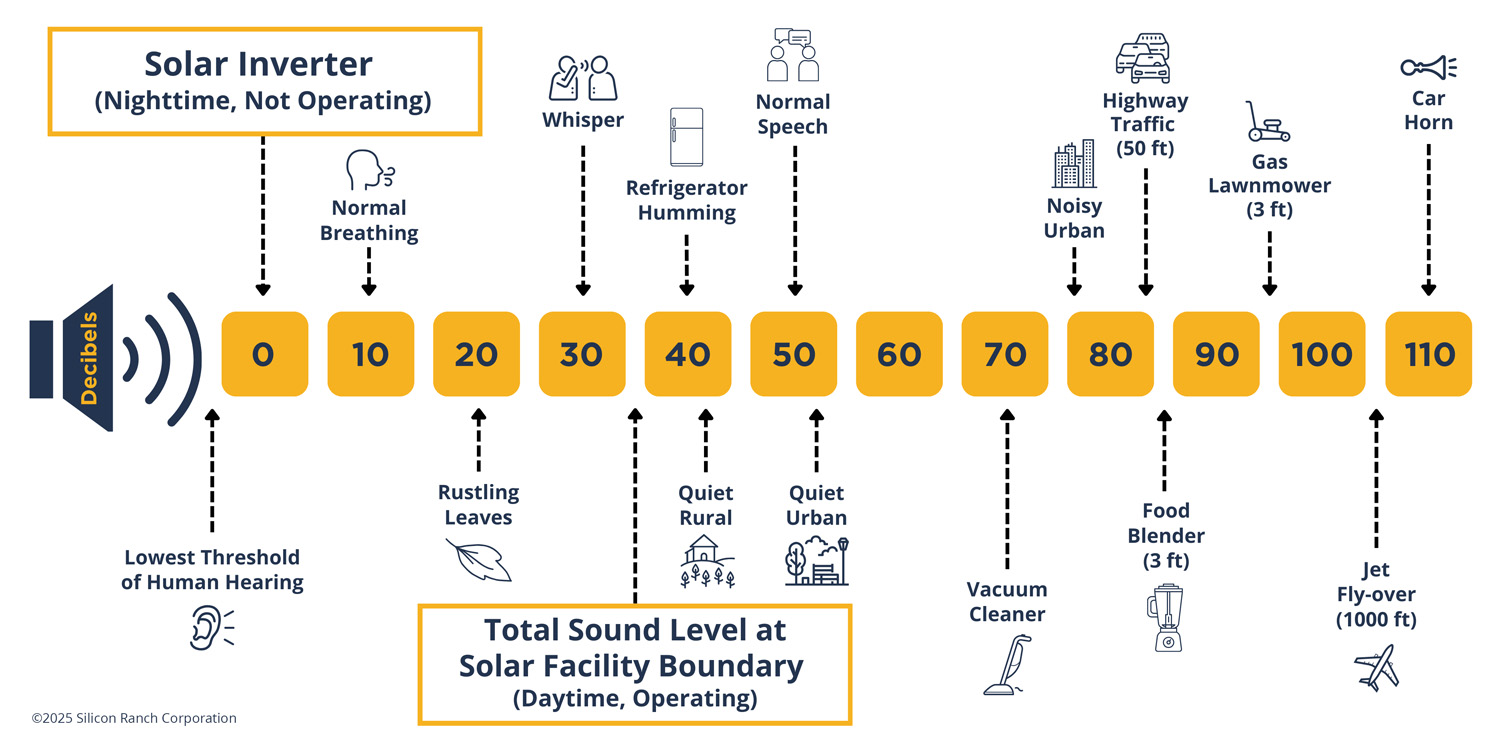
Sound Decibel Graphic

It depends. Our agricultural and regenerative ranching projects can be farmed by either local farmer partners or in-house agrivoltaics technicians.

At some projects, we partner with regenerative ranchers and local farmers to deliver full-service holistic land management, including adaptive multi-paddock grazing, that keeps the land in agricultural production and restores our project sites to functioning grassland ecosystems.

At other projects, our in-house agrivoltaics technicians manage the land. We recruit our agrivoltaics technicians primarily from rural communities and train them to help manage our lands regeneratively, including to use adaptive multi-paddock sheep grazing as the primary vegetation management tool and to restore grasslands. By employing and training agrivoltaics technicians, we are helping to build traditional jobs for the rural generation to come.

Maintaining the land regeneratively typically generates more jobs during the operations phase of a project than an average, conventionally maintained solar plant generates. We partner with or employ a diverse set of land managers, including ranchers and farmers, mowing partners, and agrivoltaics technicians recruited from rural communities. This project will create five full-time ranching jobs. 

Energy + Ag is a win-win for jobs and local economies. It provides new economic opportunities to farmers and distributes positive impacts to the broader community, through more work for veterinarians, seed and equipment purchases, and other local procurements.

Silicon Ranch never broadcast sprays herbicides or pesticides. We also refrain from spot spraying pesticides at our projects, unless required by state law where a project is located to mitigate noxious weeds determined injurious to agricultural or horticultural crops or, in some instances, to prevent small targeted amounts of vegetation from growing up into equipment that would interfere with solar generation and impede the facility’s ability to deliver power to serve homes and businesses in the long-term. When circumstances require that we use pesticides, Silicon Ranch is committed to minimizing their use, meaning that we only spot spray EPA approved herbicides—which are commonly used on timber farms—when required. We recognize that our responsibility as a good neighbor doesn’t stop at our fence line. Rather than viewing the land housing our solar projects as a liability, we recognize that land and vegetation are valuable natural resources and biological assets. When land and vegetation are managed properly, and in alignment with natural systems, we can revitalize soils, restore grassland ecosystems, increase biodiversity, sequester carbon, improve water quality, and build better solar facilities. Ultimately, through our Regenerative Energy approach, our goal is to leave the land better than we found it.

In summary, Silicon Ranch never uses vegetative growth inhibitors, nor do we blanket spray our sites with broad spectrum, non-selective herbicides. Herbicide use is limited to spot spraying of noxious weeds determined harmful to agricultural or horticultural crops and targeted spraying around inverter and transformer pads and the substation.

Our solar projects are designed with reliability and the highest performance in mind over their 40- year useful lifetimes. This 40-year view means we design the entire plant and select best-in-class equipment to last at least 40 years. Unlike some developers who may focus more on meeting minimum design criteria to reduce short-term costs, Silicon Ranch places more emphasis on reliability and the requirements of long-term ownership.

At the end of 40 years, our projects will either be repowered with new solar equipment or decommissioned. If a project is decommissioned, all system components will be removed, and the ground will be stabilized. All costs associated with the decommissioning process will be the responsibility of Silicon Ranch, not the community or local government. As Silicon Ranch will continue to own the property and will remain a member of the community, we are invested in ensuring that decommissioning will occur safely and responsibly, and that the site is in excellent condition.

Silicon Ranch purchases solar panels for our projects with end-of-life in mind and we seek the most cost-effective and environmentally responsible path for recycling modules at their end of life.

We are committed to leading industry advancements in responsible management of end-of-life solar equipment. Our commitment goes beyond recycling to repurposing, reusing, and fueling domestic manufacturing of solar panels for a circular solar economy.

To process-end-of life solar modules from Silicon Ranch projects, we have partnered with two pioneers in U.S.-based solar industry panel recycling. The first, SOLARCYCLE, offers an advanced platform that recovers approximately 95% of the value of solar panel materials, including glass and aluminum, as well as silicon, silver, copper, and aluminum. The second, First Solar, recovers approximately 90 percent of materials. Recovered module materials are returned to the solar supply chain to help fuel the growing U.S. solar manufacturing industry with a domestic supply of materials essential to the production of new solar panels. For instance, recovered aluminum from the aluminum panel frames will be used to make aluminum frames for new solar panels.

Our industry leading recycling partnerships support our commitments to advance made-in-America solar manufacturing, a circular solar economy that reduces material use and recaptures “waste” as a resource to manufacture new panels, and economic development opportunities in communities across the country.

It depends on the project, but typically projects interconnect to existing transmission lines adjacent to the property.

No. Silicon Ranch constructs photovoltaic facilities, which absorb solar energy rather than reflect it, and therefore do not heat up.

There are companies that place solar panels on top of warehouses, commercial buildings, and residential houses, but this is not what Silicon Ranch does. The first part to consider is location – utility scale solar plants need to be near a viable transmission or distribution line to allow for connection to the grid to prevent needing long, expensive transmission lines. Additionally, consolidating the solar plant into a concentrated location allows for more efficient and effective connection to the grid.

The second part to consider is the size – large warehouses tend to be between 500,000 and 1,000,000 square feet, which is approximately 12 – 24 acres. Silicon Ranch aims to build utility scale solar plants that require larger areas to generate the amount of energy necessary. Another factor is that not all existing buildings were designed or built to hold the structural load of a solar plant on the rooftops.

While there are companies that build solar plants on landfills, Silicon Ranch does not do so because building solar plants on landfills presents permitting and construction challenges, environmental challenges, such as avoiding damage to the landfill capping system, and engineering challenges, such as potential settlement of the landfill area that can lead to structural damage to the solar generating equipment.

We aim to deliver power into the communities that the power will serve. Each community has a range of siting options available, including both rooftop and ground mounted. In addition to questions of scale and structural stability, rooftop is by far the most expensive option for the installation of solar energy. Ground-mounted solar energy is the lowest cost form of new electricity generation in the United States today, and it is an important energy source for helping to keep rates low.

This will depend on the time of day, but generally, no more than ten feet high. The panels at many of our newer sites rotate to follow the sun throughout the day. At the beginning and end of the day, the solar panels will be at their highest as they will be angled 60 degrees. Around lunchtime, the panels will be at their lowest.

The supporting structures that hold the modules are designed to withstand wind loads of 105-120 mph.

We take intentional steps in our facility design, operations, and land management to ensure that stormwater runoff from each site will be reduced or not increased from the conditions that exist when we buy the property.

Most of our projects are proposed at sites where the existing land is agricultural, wooded, or a combination of both. Once a solar plant is constructed, impervious surfaces (foundation pads, equipment, gravel roadways, etc.) cover a relatively minor amount of the land housing it. So, while solar panels will be installed on the land, the stormwater will flow off the panels and across the vegetation, allowing for the water to infiltrate and evaporate or be absorbed and replenish the aquifer. Moreover, our regenerative land management practices increase vegetative cover and build soil organic matter and looser soils, leading to more water infiltration, increased water retention, and less stormwater runoff.

The reduction in stormwater runoff peak flow improves downstream flooding issues. Existing natural resources (e.g., wetlands, ponds, streams, floodplains, etc.) and associated buffer areas are field identified, delineated, reviewed by the appropriate agencies, and marked during construction to be protected. In some circumstances, it may be necessary to temporarily or permanently impact a natural resource to facilitate a crossing location (e.g., access road-stream crossing). In these situations, we secure all necessary permits and we implement associated mitigative measures.

With 23 projects in Georgia operating, under construction, or contracted, Silicon Ranch’s solar projects in Georgia create more than 6,500 construction jobs. We maintain a strong preference for hiring locally and from the military veteran community.

Once a project is approved, our Project Delivery team will work with local partners, such as the chamber of commerce, to develop a plan to engage qualified, local firms and invite them to bid on the project.

Make sure to go to the Contact Us page and fill out the Contact form for Vendors. A project representative will get back to you with more details on available work and the timing of proposals.

There are also periodic announcements regarding job fairs for local residents interested in working on these projects.

There is some truck and trailer traffic during the construction of projects, including 18-wheelers delivering supplies during installation. Prior to and throughout construction, Silicon Ranch coordinates with the community to provide a more precise operation schedule as the construction of a specific project approaches. Once operational, our sites are remotely monitored and rarely visited except for periodic and routine maintenance. This is usually accomplished with 1-2 pick-up trucks or vans, depending on the crew.

Yes, we always prefer to hire qualified, local firms when possible.

Silicon Ranch has a systematic approach to health and safety and is committed to the goal of zero recordable safety incidents. Accordingly, the team gives every consideration to safety and control measures as part of overall project design. In addition to his 25+ years of environmental, health and safety experience, Silicon Ranch’s Director of Environmental, Health, Safety, and Security—Jim Barfield, CSP, CHST—has deep credentials to lead the company’s approach to safety. Along with qualifications that include BSCP certifications, FEMA incident command, accident investigation, and OSHA 30 qualifications, he is a veteran of the United States Army as a Health Specialist of Preventative Medicine, where he educated personnel on pathogen exposure, disease and occupational illness prevention, enforced military regulations governing sanitary practice and industrial hygiene, and investigated and controlled sources of pathogen and toxin exposure both inside and outside of United States borders.

Our projects across Georgia follow and adhere to all local, state, and federal regulations including fencing, electric codes, and signage. Additionally, our projects will be monitored 24/7 so that any disturbance to the system can be quickly and safely acted upon.

Once construction commences, external to the site, we post appropriate warnings in traffic ways to alert drivers of impending truck entrances to the roadway. Internal to the site there are controls in place to regulate vehicles and heavy equipment on site.

The materials and components that comprise a solar energy generating facility are not hazardous to humans. Silicon Ranch prioritizes protection of the environment.

There is noise associated with the construction of projects, but Silicon Ranch seeks to minimize any potential disruption by limiting construction activities to normal business hours. Once operational, the sites do not generate appreciable noise. The inverters have a quiet hum when the plant is generating during daylight hours, but the noise is not audible beyond the property line. The inverters are typically located centrally on the project site, far enough away from neighboring houses to be imperceptible.

A solar farm is a collection of interconnected solar panels that are strategically placed to maximize their ability to capture sunlight and convert it to electricity. Sunlight contains little packets of energy called photons. When photons from the sun reach the solar panels, it causes energy electrons within those panels to move and in turn create an electrical current. That electric current is then sent to an inverter which converts it from DC to AC. That power is then pushed out from the solar site onto the transmission lines where the electricity is then distributed to households and businesses.

Once operational, our projects do not generate any noise that can be heard outside the facility fencing. The inverters have a quiet hum, not unlike that heard from a residential transformer. We typically have 60’-40’ setbacks around the exterior of the site, with a 100’ setback from the interior parcel. Given the location of the inverters within the fenced array, sounds from these projects are imperceptible.

Solar modules do not cause glare in houses because modules are designed to absorb (rather than reflect) as much light as possible and are covered with a protective layer of anti-reflective matte glass.

No. Responsible solar development can actually enhance, not harm, wildlife habitat.

Silicon Ranch’s approach to land management has demonstrated that responsible solar development can improve wildlife habitat. For instance, we have seen a measurable increase in bobwhite quail populations at our Hazlehurst projects in Jeff Davis County, where the previous regime of intensive tillage and herbicide use for cotton-peanut-corn farms damaged bobwhite quail populations over the past 80 years. With a transition to zero soil disturbance after construction, perennial vegetation, and properly timed mowing events, these solar projects create ground nesting bird habitat where bobwhite quail and other wildlife thrive. These healthy populations then spill over into adjacent hunting properties, where neighbors share in the benefit of this work.

In addition, Silicon Ranch has developed and funded a private Gopher Tortoise Sanctuary in partnership with Georgia Department of Natural Resources on the company’s privately owned lands in Clay County. Working together, Silicon Ranch and the Department have relocated several tortoises from surrounding projects, and have room for more. In Lee County, Silicon Ranch intentionally designed in wildlife corridors at the DeSoto project site.

Silicon Ranch takes wildlife habitat very seriously, and our investment in this sanctuary and these wildlife corridors is testament.

Our Regenerative Energy platform is an outcome driven, third-party verified holistic standard of excellence for the design, construction, and operation of solar farms.

For our ecological monitoring, we contract with Savory Institute Ecological Outcome Verification Professional Monitors to take soil samples and perform the short- and long-term ecological monitoring.

We measure and third-party verify our ecological outcomes using the Savory Institute’s Land to Market Ecological Outcome Verification assessment methodology, which was developed in collaboration with leading soil scientists, ecologists, agronomists, and an extensive network of regenerative land managers around the world. This methodology measures the health of the land as a living system. In 2022, the Savory Institute certified land housing seven Silicon Ranch solar facilities as ‘regenerative’.

If we conduct a soil carbon project at a site, we contract with Earth Optics to measure soil carbon. The soil is also tested at four laboratories, including one for agriculture analysis, during our Geotechnical testing prior to construction.
Yes, our projects follow and adhere to all local, state, and federal regulations including fencing, electric codes, and signage. Additionally, Silicon Ranch projects are monitored 24/7 so that any disturbance to the system can be quickly and safely acted upon.

With 23 projects in Georgia operating, under construction, or contracted, Silicon Ranch’s solar projects in Georgia create more than 6,500 jobs.

Our goal at Silicon Ranch is to leave the land as good, if not better, than when we initially find it.

During operation, we maintain the land using regenerative land management practices that promote long-term, deep-rooted vegetation and faster plant growth cycles. This approach, which we implement under our Regenerative Energy® platform, not only multiplies the typical beneficial outcomes of a solar project but also creates new benefits, including healing degraded soils, improving ecosystem function, and increasing biodiversity of both plants and wildlife, as well as pollinator habitat.  

Regenerative Energy came to be in large part as a result of an invitation from White Oak Pastures owner Will Harris to Silicon Ranch to visit his family’s world-renowned regenerative ranch in Bluffton. Harris introduced Silicon Ranch leadership to the methods of planned livestock grazing and other regenerative agricultural practices that his family had been deploying at White Oak Pastures for more than two decades. The result was a new partnership and Silicon Ranch’s innovative model for the solar industry, Regenerative Energy, our holistic approach to project design, construction, and land management that we now deploy across thousands of acres of land that we own and manage in the United States.


We recognize Georgia’s pride in the unique communities that make up the state and will implement the regenerative land management practices that are appropriate to each community to continue that legacy, in partnership with the local community and surrounding area.

Silicon Ranch aims to refrain from the use of any pesticides at our projects, unless required by state law where a project is located to mitigate noxious weeds determined injurious to agricultural or horticultural crops or, in some instances, to prevent small targeted amounts of vegetation from growing up into equipment that would interfere with plant performance and impede the facility’s ability to deliver power to serve homes and businesses in the long-term. When circumstances require that we use pesticides, Silicon Ranch is committed to minimizing their use, meaning that we only spot spray EPA approved herbicides – which are commonly used on timber farms – when required. We never broadcast spray herbicides or pesticides.

We recognize that our responsibility as a good neighbor doesn’t stop at our fence line. Rather than viewing the land housing our solar projects as a liability, we recognize that land and vegetation are valuable natural resources and biological assets. When land and vegetation are managed properly, and in alignment with natural systems, we can revitalize soils, restore grassland ecosystems, increase biodiversity, sequester carbon, improve water quality, and build better solar facilities. Ultimately, through our Regenerative Energy approach, our goal is to leave the land better than we found it.

We recognize Georgia’s pride in the unique ecosystems that make up the state and we are committed to designing, building, and operating our solar facilities in a way that continues that legacy, in partnership with communities throughout Georgia.

Our solar projects are designed with reliability and the highest performance in mind over their 40-year useful lifetimes. This 40-year view means we design the entire plant and select equipment to last up to 40 years. Unlike some developers who may focus more on meeting minimum design criteria to reduce short-term costs, Silicon Ranch places more emphasis on reliability and the requirements of long-term ownership.

At the end of 40 years, our Georgia projects will either be repowered with new solar equipment or decommissioned. If a project is decommissioned, all system components will be removed and the ground will be stabilized. All costs associated with the decommissioning process will be the responsibility of Silicon Ranch, not the community or local government. As Silicon Ranch will continue to own the property and will remain a member of the community, we are invested in ensuring that decommissioning will occur safely and responsibly, and that the site remains in excellent condition.

Silicon Ranch purchases solar panels for our projects with end-of-life in mind and we seek the most cost-effective and environmentally responsible path for recycling modules at their end of life.

We are committed to leading industry advancements in recycling. To process-end-of life solar modules from Silicon Ranch projects, we have partnered with two pioneers in US-based solar industry panel recycling: SOLARCYCLE, which offers an advanced recycling platform that recovers approximately 95% of the value of solar panel materials, including glass and aluminum, as well as silicon, copper, and silicon, and First Solar, which recovers approximately 90 percent of materials. Recovered module materials will help fuel the growing U.S. solar manufacturing industry with a domestic supply of materials essential to the production of new solar panels.

Our industry leading recycling partnerships support our commitments to advance domestic solar manufacturing, a circular solar economy that reduces material use and recaptures “waste” as a resource to manufacture new panels, and economic development opportunities in communities across the country.

The remaining part of the panel materials, which are made of plastics, do not have much value. SOLARCYCLE is committed to zero waste, however, and the company has found off-takers who will use the plastic for secondary applications to avoid sending panel materials to a landfill.

Hear What Georgia Communities and Partners Have to Say About Silicon Ranch